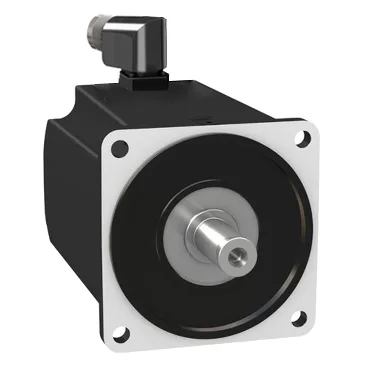
What the MH3 frame delivers on this build
The MH31901P16F2200 sits in Schneider's MH3 sizing reference and pairs a 190 mm flange with a 248 mm body length, a 38 mm keyed shaft, and a single-turn SinCos Hiperface encoder wired through rotatable right-angled connectors. The MH3 series designation covers the medium-frame servo range that drives machine-tool axes, packaging slides, and material-handling gantries. It is a three-phase brushless servo with a built-in holding brake, IP65 sealing on the standard housing, and natural-convection cooling — no external fan or blower is needed for the continuous rating, which simplifies panel integration and keeps the cabinet footprint clean.
Torque, current, and where it sits in the drive envelope
The 6750 W continuous power figure and the 16.5 N.m nominal point define the sizing envelope the integrator works inside on a steady-state axis, not the headline 32 N.m figure. Peak stall torque reaches 110 N.m (973.6 lbf.in) over the same 115 to 480 V span, with a maximum RMS current of 89.6 A and a continuous stall current of 23.2 A — the gap between continuous and peak is the acceleration headroom a motion profile can draw on for short moves without tripping the drive.
Mechanical fitment and shaft loading on the panel
Mounting is the international-standard flange pattern with 14 mm bolt holes on a 190 mm frame, an 180 mm centring collar with a 4 mm depth, and a parallel-key shaft cut 80 mm long. The 10 mm key width and 38 mm shaft diameter are sized for the gearbox and coupling choices typical of this frame — confirm the mating bore and keyseat before committing the BOM line. Maximum radial force Fr derates with speed: 2900 N at 1000 rpm, 2750 N at 2000 rpm, 2650 N at 3000 rpm, and 2600 N at 4000 rpm — the drop is the belt or gear mesh load the bearing can carry as the shaft spins faster. Run the application point on this curve, not on the static rating, otherwise the bearing life calculation is wrong.
Thermal envelope and brake duty
Copper-hot temperature is rated 135 °C, and the torque constant is specified at 120 °C — so the published torque figures are already the hot-side values, not the cold-side, which removes a derating step the integrator would otherwise apply. Natural-convection cooling means no fan failure mode to plan around, but it also caps continuous torque above the rated ambient only if the cabinet airflow is verified. The integrated holding brake pulls in at 22.5 W — the figure the safety circuit designer needs when sizing the 24 V supply and the brake-driver cut-off in an E-stop chain. Holding-brake torque tracks the motor's 32 N.m holding figure for vertical-axis locking; confirm the brake rating against the suspended-load calculation before commissioning.
Lifecycle read and the RFQ posture
No stock count, lead-time figure, or channel claim is asserted here — those are confirmed per RFQ through independent industrial distribution.