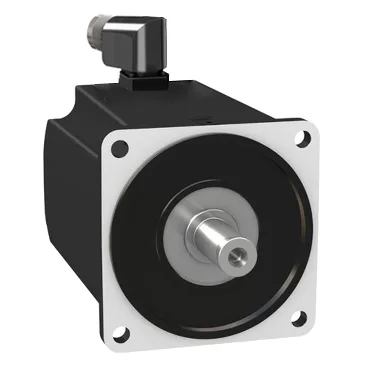
What does the MH3 frame actually deliver on the shaft
The Schneider Electric MH31902P17F2200 is a 190 mm flange-frame servo (device short name MH3, sizing reference MH31902P, motor flange size 7.5 in / 190 mm) sized around a 531.04 lbf.in (60 N.m) holding torque and a 1947.2 lbf.in (220 N.m) peak stall torque across 115...480 V, three phase operation, with natural convection cooling and a holding brake fitted as standard.
Encoder, shaft, and brake — the mechanical side of the BOM
Feedback is a Multiturn SinCos Hiperface encoder, which pairs natively with the LXM52/LXM62 drive platform and resolves absolute position over multiple turns without an external battery box on the motor — the cable carries the Hiperface protocol on the same conductors as power, simplifying the cabinet routing compared to a resolver-plus-separate-encoder topology. The shaft end is a parallel-key configuration, 1.5 in (38 mm) diameter by 3.1 in (80 mm) long with a 0.4 in (10 mm) key, no second shaft end — the 190 mm flange with a 7.09 in (180 mm) centring collar at 0.2 in (4 mm) depth and 0.6 in (14 mm) mounting holes drops onto an international standard flange footprint, so coupling and gearbox selection follows the MH3 mechanical interface rather than a special adapter. A holding brake is fitted, drawing 25 W to pull in — that figure is the holding coil power, not a release figure, so cabinet thermal budgets need to absorb 25 W of continuous dissipation per motor whenever the brake is energised in a vertical-axis hold.
Thermal envelope, IP rating, and where the motor sits in the panel
IP65 standard sealing means the MH3 frame tolerates dust ingress and low-pressure water jets — suitable for a washdown-adjacent cell on a packaging or bottling line where the cabinet sits outside the wet zone and the motor is mounted on the machine frame, not submerged. Thermal ceiling is a 275 °F (135 °C) copper-hot temperature class with natural convection cooling, so there is no integrated fan to fail — passive cooling keeps the maintenance footprint small but also means the continuous torque must be respected rather than pushed into extended S1 overload, since the only heat path is into the flange and surrounding air. Maximum radial force Fr is rated 3200 N at 1000 rpm down to 2950 N at 4000 rpm on the shaft — a belt-driven coupling needs to be sized below that envelope, otherwise the side load shortens bearing life well before the winding reaches its thermal limit.
Electrical signature for the drive commissioning file
Back-EMF constant of 108.3 V/krpm, torque constant of 1.56 N.m/A at 248 °F (120 °C), stator resistance 0.15 Ohm and stator inductance 3.86 mH — these four values are what the LXM52 or LXM62 auto-tuning routine reads at first spin, and they are the same across the 115...480 V input range because the drive handles the bus regulation, not the motor.