What kind of motor is the MH31903P02F2200, and where does it sit
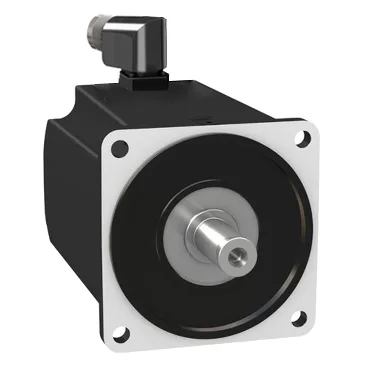
The MH31903P02F2200 is a Schneider Electric MH3-series three-phase AC servo motor sized for mid-range machine axis duty, built around a 190 mm international-standard flange with a 38 mm smooth shaft and a built-in holding brake. The feedback is a multiturn SinCos Hiperface encoder and the power connection uses rotatable right-angled connectors, which lets the wireman orient the cable exit without re-routing the harness after the motor is bolted down.
Torque envelope and how it drives drive sizing
Holding torque is 60 N.m and continuous stall torque is 65 N.m across 115 V to 480 V three-phase, so the motor can hold position against the load even with the bus sagged at the low end of the input range. Peak stall torque reaches 330 N.m and nominal torque sits at 37 N.m with continuous power up to 9560 W, which is the envelope that decides whether the pairing LXM52 or LXM62 drive has the current headroom for the acceleration profile the machine actually runs.
Speed, brake and the IP65 sealed envelope
Nominal speed is 2000 rpm on either the LXM52 or LXM62 drive at 400 V or 480 V three-phase, with a maximum mechanical speed of 3800 rpm — the latter is the ceiling the mechanical coupling has to clear, not the operating point. The holding brake pulls in at 25 W, giving a controlled stop-hold that suits vertical axes where a power-loss event must not let the load drop, and the IP65 sealing with natural convection cooling suits cabinet-adjacent or washdown-tolerant mounting without forcing a forced-air kit on the machine.
Mounting envelope and shaft load limits
The flange is 190 mm with a 180 mm centring collar and 14 mm mounting holes on the international-standard pattern, and the shaft sticks out 80 mm — so the coupling selection has to clear that protrusion before the radial load budget is spent on misalignment rather than on the process. Maximum radial force Fr is 3300 N at 1000 rpm and tapers to 3100 N at 4000 rpm, which is the figure a belt or pinion designer should work against when sizing the driven element rather than treating it as a free shaft.