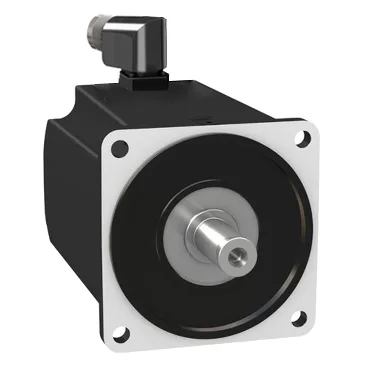
Where MH31903P06F2200 sits on the torque ladder
Peak stall torque reaches 330 N.m in the 115 to 480 V three-phase band, which is the figure that defines the worst-case transient a sizing exercise has to absorb — not the 60 N.m continuous number — and a continuous stall current of 36.1 A with a 124.5 A Irms ceiling sets the upstream drive sizing window.
Encoder, brake, and the duty envelope
Feedback is a single-turn SinCos Hiperface encoder on a smooth 38 mm shaft, paired with an integrated holding brake that draws 25 W on pull-in — the encoder protocol dictates the drive family that talks to it cleanly, and the brake call-out tells the cabinet designer to budget a 24 V brake supply on the drive's holding-brake output, not from a separate relay. Continuous power is rated at 9560 W with natural-convection cooling, so the motor dissipates its losses through the housing without a forced-air kit — that simplifies panel layout but caps the continuous-torque dwell time on a stationary axis, which is why the 60 N.m holding figure is bracketed by the 65 N.m continuous stall torque and the 330 N.m peak separately on the nameplate.
Mechanical fit on the machine side
Body length of 14.5 in (368 mm) with a 80 mm shaft extension lands this frame in the mid-size MH3 bracket, and the international-standard flange with a 180 mm centring collar at 4 mm depth and 14 mm mounting holes means it drops into the standard 190 mm bolt pattern without an adapter plate. Maximum mechanical speed is 3800 rpm and the radial-force envelope runs 3300 N at 1000 rpm down to 3100 N at 4000 rpm — the drop is small but it is the curve a belt-drive or pinion preload calculation should respect, because the maximum is set at the lowest speed and any overhung load near 3800 rpm has to be checked against the 3100 N floor.