Defining ratings at a glance
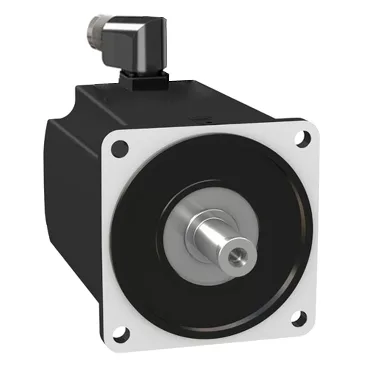
The MH31903P07A2200: Continuous mechanical output is 9560 W at a nominal torque of 37 N·m, with a 2000 rpm nominal speed on the listed drive pairings — the figure an integrator sets the axis sizing against for the steady-state load on the machine. Position feedback is a Multiturn SinCos Hiperface encoder on a smooth 38 mm × 80 mm shaft, with no second shaft end and no holding brake — the gearbox or external brake, where one is needed, is fitted downstream.
Torque envelope and stall/peak margins
Peak current Irms is 124.5 A, well above the 36.1 A continuous stall figure; the drive's peak-of-peak current limit is what times the worst dynamic event, not the continuous rating. Torque constant is 1.8 N·m/A at the 120 °C copper-hot reference, so at stall the motor sits at its thermal ceiling for a finite interval before torque begins to fall. Winding resistance is 0.13 Ω and stator inductance is 3.62 mH — the I²R loss and the current-loop time constant the drive has to control are both modest for a frame this size, which keeps the high-speed bus current under control on cyclic loads.
Mechanical fit, shaft load, and thermal headroom
Maximum radial force on the shaft is 3300 N at 1000 rpm, stepping down to 3100 N at 4000 rpm — the load on a belt, pinion, or coupling has to stay inside that envelope at the operating speed, with the overhung load and belt tension calculated against the rpm curve, not the headline number. Mounting is on the international standard flange with four 14 mm holes on the 180 mm centring collar (4 mm deep), and the power and feedback connectors are rotatable right-angle types — the housing can be clocked to the cable entry direction after the motor is bolted down, which removes the usual panel-side constraint on lead dress. Cooling is natural convection with a copper-hot limit of 135 °C and an IP65 standard seal on the body — there is no fan to fail and no forced-air ducting to plumb, which suits a sealed cabinet or a washdown-adjacent area where airborne contamination is the dominant risk.