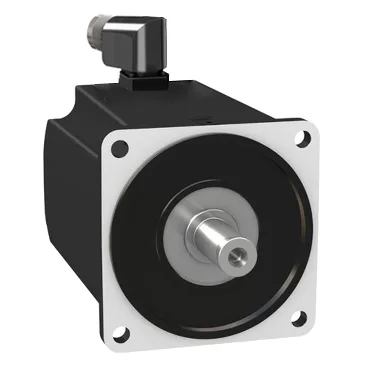
Where this motor sits on the machine
The MH31903P12F2200 is a Schneider MH3 three-phase servo motor (device short name MH3, sizing reference MH31903P) built to drive machines sized by holding torque of 60 N.m and nominal torque of 37 N.m on the LXM52 and LXM62 drive families at 400 V or 480 V three-phase supply. Packaged with a Hiperface multiturn SinCos absolute encoder, rotatable right-angled connectors, parallel-key 38 mm shaft on an international-standard 190 mm flange, it slots into indexing tables, packaging conveyors, and high-inertia wind/unwind stations where 7.75 kW continuous power and 9560 W thermal envelope are required.
Sizing the drive pairing the ratings actually demand
Peak stall torque reaches 2920.7 lbf.in (330 N.m) for short-duration overloads, against the 531.04 lbf.in (60 N.m) holding-torque figure the part name is built around — the 5.5× peak-to-continuous ratio is the envelope an integrator must respect when sizing a rapid accel/decel profile.
Mechanical envelope for the cabinet and bracket
International-standard flange mount with 180 mm centring collar (4 mm depth) and 14 mm mounting holes mates to the standard IEC 190 mm servo footprint — 368 mm body length sets the rear-of-shaft clearance an enclosure has to allow. Holding brake is fitted as standard, drawing 25 W pull-in power — for a vertical axis this is the safety element holding the load at rest, and the controller must sequence the brake against the drive enable so the motor develops torque before the brake releases.
Feedback, sealing, and what that means for the install
Multiturn SinCos Hiperface encoder delivers absolute position feedback over the rotatable right-angled connector — so the drive retains absolute shaft position across power cycles without an external battery box, simplifying cabinet wiring on machines that need to re-start from a known index. IP65 sealing with natural convection cooling (no integrated fan) means the motor is rated for dust and jet-wash environments — the 135 °C copper-hot temperature limit gives the thermal envelope, and cabinet air clearance around the frame is what carries the dissipation; there is no fan to fail in a washdown zone.