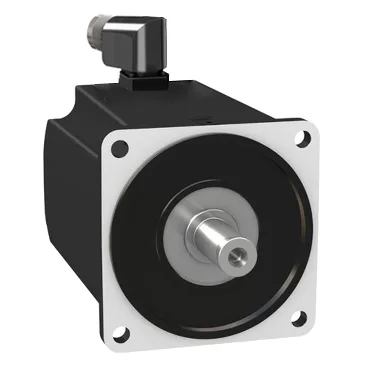
What is this motor, and where does it drop in?
The MH31903P16F2200 is a Schneider Electric MH3 series three-phase servo motor — a 190 mm flange, naturally cooled AC servo with a single-turn SinCos Hiperface encoder and an integrated holding brake, sized in the MH31903P frame and intended to mount onto a standard international flange. It is the rotor-and-feedback end of a Lexium 52 or Lexium 62 drive package: the nominal 2000 rpm point is reached on either drive at 21.3 mA control current on 400 V or 480 V three-phase rails. For panel builders and field-service techs, the IP65 rating on the body plus rotatable right-angled connectors means the motor can live close to the machine — under coolant splash, near gearbox housings, inside a food-and-bev washdown envelope — without a separate sealing enclosure.
Torque envelope at 2000 rpm
Holding torque is 60 N.m and the continuous stall torque is 65 N.m across 115 to 480 V three-phase — the winding holds the rated torque across the full Schneider drive voltage window. Nominal torque is 37 N.m at the 2000 rpm point on the Lexium 52 / Lexium 62 at 21.3 mA, so the working point sits at roughly two-thirds of the continuous torque envelope, leaving headroom for acceleration transients before the drive reaches current clamp. Peak stall torque for short-term dynamics — indexing moves, E-stop ramps — is 330 N.m; the drive must be rated to deliver the matching Irms of 124.5 A on those peaks. Continuous power reaches 9560 W with natural convection; the 135 °C copper-hot thermal ceiling is the derating anchor for hot-cabinet or motor-over-gearbox installations.
Encoder, shaft, and brake — what the kit ships with
Feedback is a single-turn SinCos Hiperface encoder, which gives absolute single-turn position over the Hiperface protocol — no batteries to replace, no homing routine on every power-up. The holding brake pulls in at 25 W; when the kit arrives, the brake is part of the motor assembly — no separate brake rectifier, no external coil driver, no missing accessory to chase down on install.
Mounting readiness before the flange goes on
Flange is 190 mm with a centring collar 180 mm diameter and 4 mm deep, drilled for 14 mm mounting hardware — dimensionally standard for the MH3 family, so a motor swap on an existing gearbox pad or faceplate lands without adapter plate machining. Radial load on the shaft is derated by speed: 3300 N at 1000 rpm falling to 3100 N at 4000 rpm, so a belt drive or pinion choice must respect the higher figure at lower speed rather than peak rpm. Cooling is natural convection only — no integrated fan, no liquid jacket — so the cabinet airflow around the motor body carries the 9560 W continuous dissipation; a blank plate or stuffed heat-sink upstream of the motor is the easiest way to overheat it.