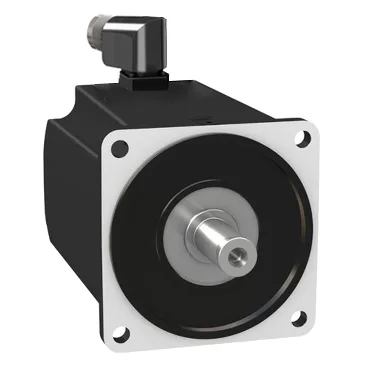
60 N.m holding torque in a 190 mm flange
The Schneider Electric MH31903P17F2200 is a member of the MH3 sizing reference MH31903P, a three-phase servo motor rated 60 N.m holding torque with a 65 N.m continuous stall torque across the 115 to 480 V operating window — sized for the mid-band of the family's torque range. Peak stall torque reaches 330 N.m at the same voltage envelope, so the motor absorbs short overload transients (shock loads, acceleration ramps) without stalling the downstream drive — a margin that matters when pairing mechanics to a high-inertia load.
Drive pairing and 2000 rpm rated speed
Continuous mechanical output is 9560 W with a maximum Irms of 124.5 A and continuous stall current of 36.1 A, so the drive's current limit must clear the stall figure comfortably and the short-term peak handling must cover the 124.5 A transient ceiling.
Encoder, brake and feedback wiring
A multiturn SinCos Hiperface encoder is fitted as the feedback device, giving absolute multi-turn position over the Hiperface protocol — a common expectation for machines requiring absolute homing after power cycling without an external battery box. The motor carries an integral holding brake drawing 25 W pull-in power, with rotatable right-angled connectors for the power and feedback cabling — the rotatable housing lets the wireman orient the lead exit to suit the cabinet layout without re-routing the loom.
Shaft, flange and IP65 sealing
IP65 sealing is the standard rating, so the motor tolerates dust and low-pressure water jets — acceptable for general factory environments but not for full washdown duty; mounting the unit away from direct hose-down zones is the usual deployment practice. Permissible radial shaft load runs from 3300 N at 1000 rpm down to 3100 N at 4000 rpm, a typical curve for a 190 mm-frame servo — drives mounted with a pinion or belt should confirm the radial load at the operating point stays inside the envelope to preserve bearing life.
Thermal and electrical constants for sizing
Thermal copper-hot rating is 135 °C with natural-convection cooling — there is no integrated fan, so derating starts at the cabinet ambient and the motor relies on its mounting surface and surrounding airflow to dissipate the 9560 W continuous figure.