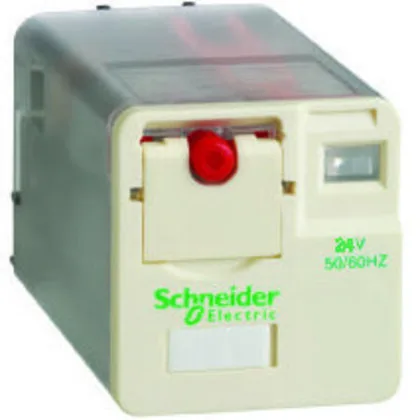
The Schneider Electric RUMC2AB1B7 is a plug-in relay from the Harmony Relay range, carrying the category code 21127-ZELIO ICE CUBE RELAYS. It is a 2 C/O (two changeover) contact relay with a 24 V AC coil, rated for 10 A in AC-1 resistive duty per IEC. The lockable test button lets a panel builder manually latch the contacts during commissioning without energizing the coil — useful when checking wiring continuity before power-up. The 24 V AC control voltage has a tolerance band of 19.2 to 26.4 V AC, so a lightly loaded control transformer that reads 26 V at no load is still within spec. Drop-out threshold is at least 0.15 Uc AC, meaning the relay releases cleanly when the control signal falls below about 3.6 V AC — no chatter on a sagging line.
The NO contacts carry 10 A AC-1/DC-1 per IEC, 12 A at 28 V DC-1 per UL, and 16 A at 277 V AC-1 per UL. The NC contacts are rated 5 A AC-1/DC-1 per IEC. AC-1 is resistive load — heaters, incandescent lamps, resistive elements. If you are switching a motor contactor coil or a solenoid, that is AC-15 duty, and you need to derate. Maximum switching capacity is 2500 VA AC or 280 W DC, with a maximum switching voltage of 250 V AC or 250 V DC. Minimum switching is 10 mA at 17 V, 170 mW — so it will reliably wet low-signal loads like a PLC digital input. Contact material is silver-nickel (AgNi), a standard choice for general-purpose switching. Electrical durability is 100,000 cycles at rated resistive load; mechanical durability is 5,000,000 cycles. The utilization coefficient is 20 %, meaning the relay is rated for intermittent duty at 1200 cycles/hour under load — continuous full-load cycling at that rate will exceed the thermal capacity of the contact set.
Standards, approvals, and environmental ratings
The RUMC2AB1B7 is certified to EN/IEC 61810-1 (electromechanical elementary relays), CSA C22.2 No 14, and UL 508 (industrial control equipment). Rated insulation voltage is 250 V IEC, 300 V CSA/UL. Vibration resistance is 3 gn (operating) and 4 gn (non-operating) over 10 to 150 Hz per EN/IEC 60068-2-27. Shock resistance is 10 gn in operation and 10 gn non-operating. Dielectric strength is 1500 V AC between contacts, 1550 V AC between coil and contact, and 1550 V AC between poles — adequate for 250 V AC line isolation in a basic insulated panel.