290 W continuous, 1.5 N.m peak — sizing the drive
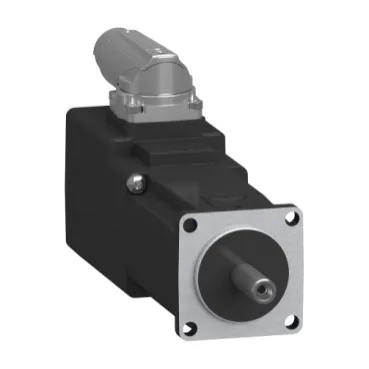
The SH30402P0DF4000 from Schneider Electric is a current-production servo motor with integrated holding brake in the SH3 series, sized at 40 mm flange and built for panel-side mounting through the standard international flange footprint. Continuous mechanical output reaches 290 W, with nominal torque stepping from 0.37 N.m on 230 V single-phase down to 0.31 N.m on 400 V or 480 V three-phase — the figure a sizing engineer should pin to the BOM, not the headline stall. Peak stall torque is 1.5 N.m on 480 V three-phase, so the drive must reserve headroom above the 0.31 N.m nominal point — a 5× burst factor that maps cleanly onto high-acceleration moves on a small parts-handling axis. Maximum mechanical speed is 9000 rpm at 400 V and 480 V three-phase, but only 4000 rpm at 230 V single-phase; running this motor off a single-phase 230 V supply costs more than half the speed envelope and is the difference between a feasible machine cycle and a stalled one.
Hiperface DSL single-cable link, 32768×4096 turns
Feedback is an absolute multiturn Hiperface DSL encoder at 32768 points/turn × 4096 turns resolution, terminated through a quicklock rotatable right-angled connector — a single-cable hybrid power-and-feedback link that cuts the cable count to the drive and lets the machine builder route through tight cable chains without a second signal cable. Shaft interface is a smooth 8 mm diameter × 25 mm long stub with an IP65 motor body and IP54 shaft bushing without shaft seal ring. IP65 on the body means the motor housing tolerates jet washdown and dust ingress on a food-grade or machine-tool envelope — the shaft entry drops to IP54 because there is no shaft seal ring fitted, so liquid creeping along the shaft is not sealed against.
Brake, current, and electrical constants
Electrical constants follow the SH3 compact class: torque constant 0.26 N.m/A at 120 °C, back-EMF constant 18 V/krpm at 20 °C, stator resistance 11.6 Ohm and inductance 12.8 mH. The 5-pole stator and natural-convection cooling place this firmly in the low-inertia small-format bracket — flange temperature limits reach the 130 °C copper-hot class, so adjacent cabling must be rated above the usual 80 °C jacket for continuous-duty panel builds.