Speed and torque across supply voltages
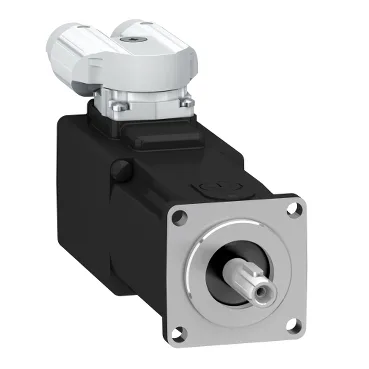
The SH30402P17F2100: This SH3 servo motor delivers 4000 rpm nominal on single-phase 115 V or 230 V, and 9000 rpm on three-phase 400 V or 480 V supply. The nominal torque ranges from 0.292 N.m on single-phase to 0.31 N.m on three-phase, with a peak stall torque of 1.5 N.m at 480 V three-phase. The continuous stall torque is 0.39 N.m across the three-phase voltage range, and the holding brake provides 0.4 N.m — enough to hold a vertical axis load at rest without continuous power to the motor windings.
Encoder, feedback, and integration constraints
Fitted with an absolute multiturn SinCos Hiperface encoder — this is a single-cable feedback system that reports absolute position over multiple shaft revolutions, so the controller knows the axis position immediately on power-up without a homing move. The rotatable right-angled connector allows the cable exit to be oriented to suit tight cabinet layouts. The motor flange is 40 mm (IEC standard), with a 30 mm centring collar and 2.5 mm collar depth. Four mounting holes on a 4.5 mm diameter circle secure it to the machine frame. The 8 mm shaft with a 3 mm parallel key and 25 mm shaft length is a common interface for small couplings and pulleys.
Thermal and electrical parameters for drive sizing
The stator resistance is 11.6 Ohm and inductance 6.4 mH — these values set the electrical time constant and influence the current-loop tuning in the servo drive. The back EMF constant is 18 V/krpm at 20 °C, and the torque constant is 0.26 N.m/A at 120 °C copper temperature.
Environmental protection and cooling
IP65 rated per IEC 60034-5 on both the motor body and the shaft bushing — this means the motor is dust-tight and protected against low-pressure water jets from any direction. Suitable for washdown environments in food processing or packaging lines where hose cleaning is routine. Cooling is by natural convection — no external fan or forced air required. This simplifies installation in clean-room or dust-sensitive areas but means the continuous torque rating assumes free air circulation around the motor housing.