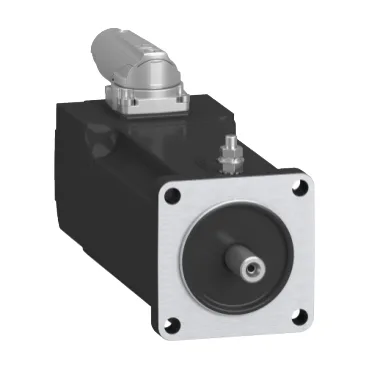
What the SH30551P0AA4100 actually is
The SH30551P0AA4100 is a member of the SH3 family of low-inertia AC servo motors, identified on the rating plate by sizing reference SH30551P and built on a 55 mm international-standard flange. The shaft side is a smooth (non-keyed) 9 mm journal running 20 mm out of the housing, and feedback is an absolute single-turn Hiperface DSL encoder read over the single-cable quicklock connector — there is no separate resolver or second feedback cable to land at the drive.
Speed, torque, and power envelope across the supply range
Nominal speed scales with the DC bus the drive presents: 4000 rpm on a single-phase 230 V supply, 8000 rpm on a three-phase 400 V bus, and 9000 rpm on a three-phase 480 V bus. The motor's 9000 rpm mechanical ceiling is therefore reached only on 480 V three-phase, and that is the working point the rest of the rating table is anchored to. Continuous output is 290 W on both 400 V and 480 V three-phase, dropping to 160 W on 230 V single-phase where the lower bus voltage limits the constant-power region. Nominal torque follows the same pattern: 0.5 N.m at 230 V single-phase versus 0.35 N.m at 400 V and 480 V three-phase — the higher speed on the three-phase rails trades torque for power at the same current envelope. Continuous stall torque is 0.42 N.m across the full 115 to 480 V three-phase range, with peak stall torque 1.5 N.m — roughly 3.6× the continuous figure — for acceleration and trip-recovery transients. The continuous stall current of 0.73 A scales to a 3-second peak of 2.9 A, which is also the Irms ceiling the drive must deliver for short bursts.
Electrical constants the drive commissioning has to match
Torque constant is 0.58 N.m/A at a 120 °C winding, with a back-EMF constant of 40 V/krpm at 20 °C — the two figures track each other and let the drive's current loop be sized directly from the requested torque. Stator resistance is 41.8 Ohm and inductance 37.13 mH on a 3-pole winding; the L/R ratio sets the achievable current-loop bandwidth before the drive runs out of voltage headroom. Winding hot-spot is rated to 130 °C and cooling is natural convection — no fan, no liquid, no external blower to specify or fail. The motor body and shaft bushing both meet IP65 to IEC 60034-5, which covers dust-ingress protection and jet-wash tolerance on a packaging or food-adjacent line; the shaft seal is what keeps washdown fluid out of the bearing cavity.
Mechanical envelope and shaft-side load budget
Radial shaft load is rated to 340 N at 1000 rpm, derating as speed rises, and maximum axial force is 40 N — coupling selection (rigid bellows, elastomer spider, or timing-belt idler) has to stay inside both envelopes, with the radial figure usually the binding constraint on belt-driven axes.
Sourcing posture for the BOM line
Lifecycle status is recorded as current production on the manufacturer's product record, so this part number remains a qualified slot on an existing BOM rather than a re-engineering exercise. The cable-end quicklock connector and the single-cable Hiperface DSL feedback mean no separate encoder cable has to be added to the BOM for the drive-end mating half.