How the SH30551P0BF4000 fits a small-axis servo loop
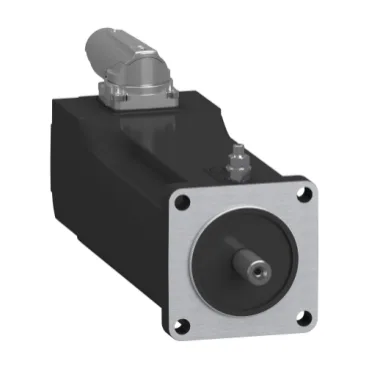
The Schneider Electric SH30551P0BF4000 is the braked version of the SH3 servo platform, sized for low-inertia point-to-point axes where the load has to hold position when the drive stage is de-energised. The 55 mm flange and 159 mm body length fit the standard short-footprint servo envelope, so it drops into typical cabinet-side machines without a mechanical redesign. Three supply rails are called out on the nameplate: 230 V single-phase yields 4000 rpm and 0.5 N.m nominal torque, while 400 V and 480 V three-phase both push to 8000 rpm and 9000 rpm respectively with 0.35 N.m nominal. Continuous power lands at 290 W on the three-phase rails and 160 W on the single-phase rail, so the drive sizing decision is really a question of which mains the cabinet sees.
Torque envelope and where the brake earns its place
Continuous stall torque is 0.42 N.m across the 115–480 V range, with peak stall up to 1.5 N.m for short accel/decel bursts. A 3 s peak current of 2.9 A Irms is the figure to hand the drive sizing tool — it sets the dynamic torque ceiling before the drive starts clipping the current loop. The integrated holding brake delivers 0.8 N.m of static torque at 10 W pull-in power, enough to lock a vertical or inclined axis against gravity when the drive stage drops out. Because the brake is fail-safe spring-applied, it holds without encoder feedback — the Hiperface DSL multiturn absolute encoder simply keeps absolute position so the controller does not need a homing routine on every power-up.
Mechanical envelope and cabinet-side integration
The international-standard flange with a 40 mm centring collar and 5.5 mm mounting holes matches the common 55 mm servo footprint, so gearhead and coupling selection stay inside the SH3 ecosystem. Shaft is 9 mm diameter smooth-bore, 20 mm long, which dictates the coupling bore and the keyway decision on the driven side. Maximum radial load is 370 N at 1000 rpm on the shaft and 40 N axial, both figures falling with speed and load distance — bearing life on a belt-coupled axis is normally driven by the radial figure, while a direct-coupled pinion usually sets the axial limit. Natural convection cooling keeps the thermal path simple: no fan to clean or fail in a sealed cabinet. Sealing is rated IP65 on the motor body and IP54 at the shaft bushing when no shaft seal is fitted, per IEC 60034-5. That puts the SH3 inside most factory-floor enclosures and light washdown areas, but it is not an IP67K rating — if the application is a food-and-bevery line with direct spray, plan for a shaft seal or a different motor. Electrical connection is a rotatable right-angle quick-lock connector, which keeps the cable exit flexible inside the cabinet.
Drive matching and electrical constants
Torque constant is 0.58 N.m/A at 120 °C and back-EMF constant is 40 V/krpm at 20 °C — both scale together so the drive's current loop and voltage headroom can be planned from the same pair of numbers. Stator resistance is 41.8 Ohm and inductance 37.13 mH, typical for a small-frame servo and consistent with the 2.9 A Irms ceiling and 3-pole construction. Hiperface DSL on a single cable carries both power and feedback back to the drive, which simplifies the cabinet wiring and reduces the number of connectors that can work loose on a vibrating axis. Maximum mechanical speed is 9000 rpm — the drive should be configured so its overspeed detection trips inside that ceiling.
Lifecycle and ordering posture
Lifecycle stage is recorded as current, so the SH30551P0BF4000 is in normal production. No official successor or cross-reference appears on the record. For a BOM position the practical sourcing posture is to quote against an RFQ — independent distribution carries the line and confirms lot-traceable availability and pricing at quote time, without claiming same-day stock on a motor built to order.