Where this motor sits on its torque–speed map
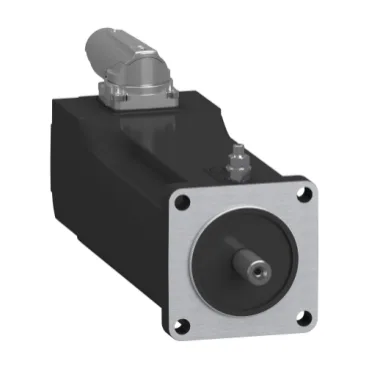
The Schneider Electric SH30551P0BF4100 is an SH3-series AC servo with integrated holding brake, sized at a 55 mm flange and 159 mm body length, and ships in the current production stage per the manufacturer record. Nominal torque depends on which bus the drive is running: 0.5 N.m at 230 V single phase drops to 0.35 N.m on both 400 V three phase and 480 V three phase rails — useful when the same axis is being evaluated against 230 V vs 400/480 V cabinet supplies. Nominal speed tracks the same rail split: 4000 rpm at 230 V single phase, 8000 rpm at 400 V three phase, and 9000 rpm at 480 V three phase; maximum mechanical speed is 9000 rpm. Continuous output power is 160 W at 230 V single phase and 290 W at both 400 V and 480 V three phase — the 230 V rail is the limiter for steady-state shaft work on this frame.
Sizing headroom: peak stall, continuous stall, and current
Peak stall torque is 1.5 N.m across 115 V to 480 V three phase, giving roughly 3× the nominal torque envelope as instantaneous overload headroom for acceleration phases — the drive's current limit, not the motor's thermal rating, is what defines how long that peak can be held. Continuous stall torque is 0.42 N.m at 115 V to 480 V three phase, with a continuous stall current of 0.73 A — so a thermally-constrained sizing point (zero rpm, holding a stationary load) sits below the nominal torque figure rather than at it. Maximum Irms and the 3-second peak output current both land at 2.9 A, which is the current ceiling a commissioning engineer should configure as the axis peak limit in the drive. The torque constant of 0.58 N.m/A at 120 °C and a back-EMF constant of 40 V/krpm at 20 °C give a clean 7.2 A·krpm/V ratio that drive autotune routines can use to cross-check the current-loop gain before the first move command.
Feedback, brake, and shaft-side mechanics
Feedback is an absolute multiturn Hiperface DSL encoder on a quick-lock rotatable right-angle connector — the single-cable DSL link keeps the cabinet wiring to one hybrid cord and lets the drive resolve absolute position without a battery box on the motor. The integrated holding brake pulls in at 10 W and delivers 0.8 N.m of holding torque — sized for vertical-axis static hold rather than dynamic stopping; for emergency-stop dynamic braking the drive's regen/absorber circuit still does the work. The shaft is 9 mm diameter, 20 mm long, smooth (no keyway), with a maximum radial force of 370 N at 1000 rpm and a maximum axial force of 40 N — both figures drop with speed and must be derated against the actual mounting distance per the shaft-load curve in the product drawing.
Panel-side mounting and environment
The motor is sealed to IP65 on both the motor body and the shaft bushing per IEC 60034-5, so it tolerates washdown and dusty cell-side mounting as long as the mating connector is seated and the shaft seal is intact. Cooling is natural convection with no integrated fan — for continuous-torque applications at the upper end of the rating, verify the motor's mounting flange is bonded to a thermally-conductive surface or heatsink to stay within the 130 °C copper-hot limit. Mechanical fit is an international-standard flange with a 40 mm centring collar at 2 mm depth and 5.5 mm mounting holes — drop-in compatible with the SH3 family footprint.
Sourcing posture for the BOM line
The part is recorded as current production by the manufacturer, with no official successor or cross-reference on the family record — the existing MPN stays the qualified BOM entry until the vendor announces otherwise.