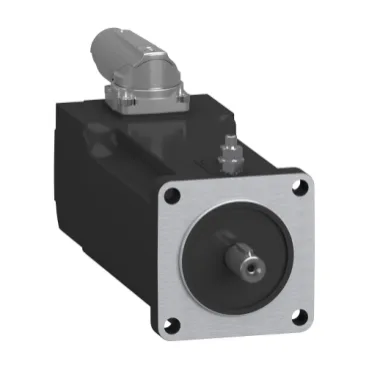
What the SH3 frame delivers at 0.5 N.m
The Schneider Electric SH30551P1AA4000 sits in the SH3 series as a 55 mm flange servo motor with 0.5 N.m nominal torque at 230 V single phase, 0.35 N.m at 400 V three phase, and the same 0.35 N.m figure at 480 V three phase — meaning the continuous working point is set by which rail you drive it from, not by a single rated torque. Nominal speed is 4000 rpm at 230 V single phase, 8000 rpm at 400 V three phase, and 9000 rpm at 480 V three phase, with a maximum mechanical speed of 9000 rpm — so the 480 V rail is the one that actually exercises the upper end of the speed envelope without hitting the ceiling. Continuous output power is 160 W at 230 V single phase and 290 W at 400 V and 480 V three phase, with 290 W also listed as the continuous power figure — so the three-phase rails deliver roughly 1.8× the single-phase continuous power at the same frame size.
Torque, current, and the loop the drive has to close
Peak stall torque is 1.5 N.m at 115 to 480 V three phase against a continuous stall torque of 0.42 N.m — so the motor can pull roughly 3.6× its continuous rating for short transients, which is the headroom acceleration reserves draw from. Maximum current Irms is 2.9 A and the 3-second peak output current is also 2.9 A, with a continuous stall current of 0.73 A — the drive sizing question is whether the servo amplifier can source 2.9 A Irms into a stator resistance of 41.8 Ohm with a 37.13 mH inductance, not whether it can hold the continuous stall figure. Torque constant is 0.58 N.m/A at 120 °C and back-EMF constant is 40 V/krpm at 20 °C — the standard Ki/Kv pair a controls engineer uses to back-calculate the current command from a demanded torque and to predict bus regeneration at top speed.
Feedback and the cabling that won't fight the cycle time
Encoder type is absolute single turn Hiperface DSL and the electrical connection is a rotatable right-angled quick-lock connector — DSL is a single-cable protocol carrying power and feedback on one pair, so the cabinet-side wiring collapses to one hybrid cable per axis and the distributed-clock skew question becomes a cable-length and shielding question rather than a second-connector question. The motor body carries IP65 per IEC 60034-5 and the shaft bushing without a shaft seal ring is IP54 — so the wet-side rating is IP65 on the housing but drops to IP54 where the shaft exits, which matters for washdown or food-grade skids where the seal stack is the wet barrier.
Mechanical fit on the machine
Shaft diameter is 9 mm with a 20 mm shaft length and a parallel key at 3 mm key width, maximum radial force Fr is 340 N at 1000 rpm and maximum axial force Fa is 40 N — the radial load figure falls as speed rises, so a belt drive or pinion mounted outboard of the bearing needs to be re-checked against the Fr curve at the operating speed, not at 1000 rpm. Cooling is natural convection and the temperature copper hot limit is 130 °C — no integrated fan, so cabinet airflow or a cold plate carries the thermal budget at the continuous stall point.