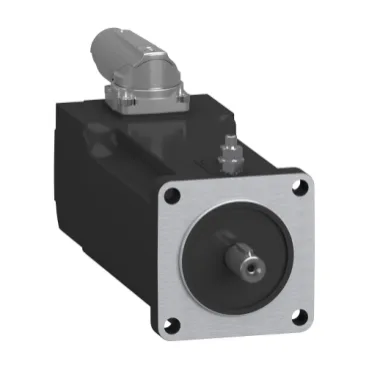
What the SH30551P1BA4000 is on the SH3 line
The SH30551P1BA4000 is a member of Schneider's SH3 servo family, with a 55 mm flange and an international standard flange mounting footprint, identified on the sizing sheet as SH30551P. The 'BA4' suffix points to a Hiperface DSL absolute multiturn feedback device — the single-cable encoder/power link that keeps the cabinet wiring down to a quick-lock rotatable right-angle connector on the motor body.
Speed-torque envelope across 230, 400 and 480 V
On 230 V single phase the motor delivers its strongest continuous figure: 0.5 N·m nominal torque at 4000 rpm, 160 W continuous output. Stepping up to 400 V three phase or 480 V three phase shifts the operating point higher up the speed range — 8000 rpm at 400 V and 9000 rpm at 480 V — but the nominal torque settles at 0.35 N·m in both cases. The continuous power ceiling is 290 W on the 400 V and 480 V supplies, so the motor trades torque for speed when you run it from a three-phase bus. Peak stall torque is 1.5 N·m across the full 115…480 V three-phase range, with a 2.9 A Irms short-term current ceiling. That is roughly three times the 0.5 N·m nominal figure on the 230 V winding — useful sizing headroom for acceleration ramps, but the 3-second current peak of 2.9 A is the binding limit, not the nominal torque.
Sizing, electrical signature and drive pairing
The motor presents a 41.8 Ω stator resistance and 37.13 mH stator inductance — a high-resistance, low-inductance profile that suits the current-loop bandwidth of modern digital servo drives. The torque constant is 0.58 N·m/A at 120 °C winding temperature and the back-EMF constant is 40 V/krpm at 20 °C, so a drive commissioning engineer can read the steady-state bus current straight off the commanded torque without compensating for an unusual motor constant. The continuous stall current is 0.73 A against a continuous stall torque of 0.42 N·m at 115…480 V three phase — the figure that governs a vertical-axis hold under power, not the higher nominal rating. Copper-hot temperature class is 130 °C, the standard insulation grade for industrial servos, and natural convection is the only cooling path: no integrated fan, so the panel environment has to leave headroom around the motor body.
Mechanical envelope, shaft loads and IP rating
Length overall is 132.5 mm on a 55 mm flange with a 40 mm centring collar (2 mm depth) and four 5.5 mm mounting holes — the standard IEC frame footprint for this class, so a swap-in to a comparable SH3 or third-party 55 mm servo drops into the same bracket pattern. Maximum radial load is 370 N at 1000 rpm and maximum axial load is 40 N, which is typical of small-flange servos and limits the use of belt drives with large pulleys or long cantilevered couplings. The motor body is IP65 per IEC 60034-5, and the shaft bushing is IP54 without a shaft seal ring — adequate for plant air and washdown-light areas when the cable entry is properly torqued, but a food-and-beverage line expecting IP67 on the wet end needs the sealed-shaft variant. Maximum mechanical speed is 9000 rpm, so a drive commanded above the 480 V nominal speed range has to respect that ceiling or risk bearing damage.