Where this motor sits in the SH3 family
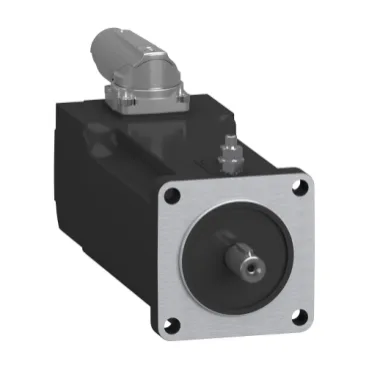
The SH30551P1BA4100: The device short name is SH3 and the sizing reference SH30551P, which pins this unit to a 55 mm flange frame within the SH3 servo family — the standard mounting footprint for compact machines where panel depth and rotor inertia both matter. Note that the listing flags 'Without' for the integrated holding brake even though the catalog path reads 'Servo Motors with Brake' — verify this configuration when committing to a BOM line, since SH3 siblings differ on brake fitment at the same flange size.
Torque, speed and power envelope by supply
Nominal torque is 0.5 N.m at 230 V single phase, stepping down to 0.35 N.m at both 400 V and 480 V three phase — the lower-voltage single-phase rating is the generous end of the envelope, so a drive selection around 230 V gives the buyer the most torque per amp on the nameplate. Nominal speed tracks the supply voltage too: 4000 rpm at 230 V single phase, 8000 rpm at 400 V three phase, and 9000 rpm at 480 V three phase, with a 9000 rpm mechanical ceiling that no operating point exceeds. Continuous output power is 290 W at both 400 V and 480 V three phase, and drops to 160 W at 230 V single phase — the three-phase supply headroom is what unlocks the rated continuous power figure for sustained-duty applications. Peak stall torque is 1.5 N.m across the 115–480 V three-phase range, and continuous stall torque 0.42 N.m over the same span — three times the rated continuous torque is available for acceleration and overload transients, which dictates the drive's current-boost capability rather than continuous rating.
Drive matching — the electrical constants the servo amp needs
Torque constant is 0.58 N.m/A at 120 °C and the back-EMF constant is 40 V/krpm at 20 °C — the ratio is consistent for a permanent-magnet servo and lets the drive calculate current-loop gains without a motor ID autotune pass in most cases. Stator resistance is 41.8 Ohm with 37.13 mH inductance — a high-resistance, moderate-inductance profile that limits the absolute current slew but suits low-voltage DC-bus drives where the bus voltage is the constraint, not the motor. Maximum current Irms and the 3-second peak output current both sit at 2.9 A, with continuous stall current 0.73 A — the drive sizing window is therefore roughly 0.73 A continuous / 2.9 A peak rather than the headline power figure alone.
Feedback loop and cabling
The encoder is an absolute multiturn Hiperface DSL — a single-cable digital protocol that carries power, position feedback and motor temperature over one quick-lock connector, so the cabinet wiring collapses to a power lead and one hybrid cable rather than separate feedback and resolver pairs. The electrical connection is a quick-lock rotatable right-angled connector — useful in cabinets where the cable entry needs to follow the trunking rather than the motor orientation, and where shaft-side access is tight.
Mechanical footprint, shaft and sealing
The motor flange is 55 mm with an international standard flange mount, body length 132.5 mm, shaft diameter 9 mm with a 20 mm shaft length and a 3 mm parallel key — the keyed shaft is sized for light-duty couplings and small pinions rather than belt drives. Maximum radial load is 370 N at 1000 rpm and maximum axial load 40 N — ratings that govern belt tension and pinion mesh loads; both drop as shaft speed rises, so high-rpm applications stay inside the curve by reducing the overhung load. IP65 protection extends to both the motor body and the shaft bushing per IEC 60034-5, so the unit tolerates dust and low-pressure water jets — typical for indoor machine enclosures, packaging lines and the washdown-adjacent zones of food machinery where direct high-pressure cleaning is not expected at the motor. Cooling is natural convection with no integrated fan, so derating begins above the rated ambient — cabinet airflow or a cold plate keeps the motor inside its thermal envelope, and the 130 °C copper-hot temperature is the trip point rather than the operating point.