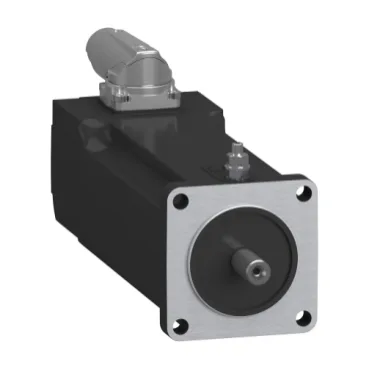
SH3 frame, 55 mm flange, 0.75 N·m nominal
The SH30552P0BA4000: Let me show you why the 55 mm flange and the four-hole 5.5 mm pattern matter: an integrator swaps this unit into the same shaft height and pilot diameter as the rest of the SH3 line, so a panel-builder can substitute across the SH30552 reference without re-machining the machine bracket. The 40 mm centring collar and 2 mm recess sit on the standard EN mounting footprint for this frame size.
Nominal speed climbs with supply: 4000 rpm at 230 V single phase, 8000 rpm at 400 V three phase, 9000 rpm at 480 V three phase, and the 0.75 N·m nominal torque at 230 V single phase drops slightly to 0.63 N·m at 400 V and 480 V three phase because the higher speed keeps the same 530 W continuous power on the shaft. Ask the dumb question now — why does torque fall at higher speed? Because mechanical power is torque × angular velocity, and 530 W is the continuous ceiling the thermal envelope can sustain. Peak stall torque is 2.5 N·m across 115 to 480 V three phase, which is roughly three-and-a-third times nominal — the figure that decides whether the drive can accelerate the load through the worst-case inertial step on the line. The 9000 rpm maximum mechanical speed is also the speed ceiling the bearings and balancing are rated for; never command past it from the controller ramp, even briefly.
Encoder, shaft, and the "with brake" family note
Feedback is an absolute multiturn Hiperface DSL encoder — single-cable digital protocol, so only one connector runs to the drive and the absolute position survives a power cycle without a homing routine on every restart. The shaft is a smooth 9 mm diameter by 20 mm long, and the listing places this motor in the "Servo Motors with Brake" category even though the holding-brake field reads "Without" — meaning this SKU is the brake-less variant in a family that otherwise ships with a fail-safe parking brake.
Current and thermal envelope
Continuous stall current is 1.2 A, Irms ceiling 4.8 A, and the 3-second peak output current is also 4.8 A — meaning the drive can command up to four times continuous current for a 3 s burst, but not beyond, which sets the accel/decel window on a fast index move. The 130 °C copper-hot temperature is the thermal trip the winding protection enforces, not a normal operating point. Stator resistance is 17.4 Ohm and stator inductance is 18.2 mH — a relatively high-resistance winding typical of a small-frame servomotor that trades off top-end efficiency for higher starting torque per amp. Cooling is natural convection only, so derate continuous output if the motor is mounted inside a sealed cabinet without airflow across the body.
Sealing, mounting loads, and the connector
The motor body carries an IP65 rating per IEC 60034-5 — fully dust-tight and protected against water jets, suitable for a washdown food-and-beverment cell or an outdoor cabinet — while the shaft bushing without a shaft seal ring is rated IP54, which is the dust/splash level the bushing alone provides. Maximum radial force on the shaft is 190 N at 8000 rpm and maximum axial force is 40 N; both must be respected by the coupling and belt choice or bearing life collapses early. Electrical connection is a quick-lock rotatable right-angle connector — the orientation can be set at install so the cable exits cleanly toward the drive cabinet without a hard bend. The motor is three-phase, three-pole, and the feedback rides over the same connector on the Hiperface DSL link.