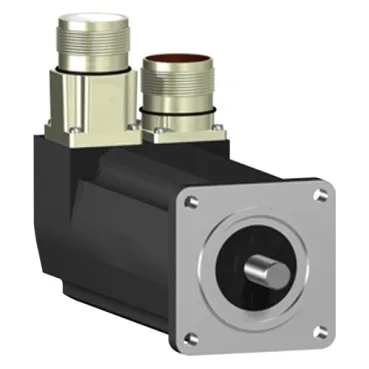
530 W continuous, 8000 rpm ceiling — speed/torque depends on supply
The SH30552P12A1000: This SH3 frame servo motor delivers 530 W continuous power, but the speed and torque you actually get depend on the supply voltage and phase configuration you feed it. On three-phase 400 V or 480 V, it spins up to 8000 rpm with nominal torque of 0.63 N·m. Drop to 230 V single-phase and max speed halves to 4000 rpm, torque bumps to 0.75 N·m. At 115 V single-phase, you're at 2000 rpm and 0.77 N·m. Peak stall torque is 2.5 N·m across the 115–480 V three-phase range — that's the short-term acceleration ceiling before the drive current limit kicks in at 4.8 A.
Absolute multiturn Hiperface — no homing cycle needed
The encoder is an absolute multiturn SinCos Hiperface type — it remembers position through power cycles, so a homing routine isn't required on every startup. That saves time on multi-axis lines where you'd otherwise re-reference each axis after a power loss. Back EMF constant is 40 V/krpm at 20 °C; torque constant is 0.59 N·m/A at 120 °C copper hot. These numbers let you size the drive's voltage headroom and current loop gain without guessing.
No holding brake — plan for external hold on vertical loads
This variant ships without a holding brake. If the application is a vertical axis or any load that can back-drive the motor when power is off, you need an external brake or a counterbalance — the motor alone won't hold position. The 55 mm flange (NEMA 23 equivalent) and 9 mm shaft with parallel key are standard for this power class. Shaft length is 20 mm, key width 3 mm — fits common coupling and pulley bore dimensions.
IP54 shaft bushing, IP65 motor body — watch the seal ring
The motor body carries IP65 per IEC 60034-5, but the shaft bushing without the optional shaft seal ring is only IP54. If the installation sees washdown or coolant spray, spec the shaft seal ring to keep the front bearing dry. Cooling is natural convection — no fan, so the motor relies on its own surface area and the mounting flange for heat dissipation. In a confined cabinet or high-ambient environment, derate the continuous torque or add forced air. Maximum radial force on the shaft drops from 370 N at 1000 rpm to 190 N at 8000 rpm — belt-drive or overhung load applications need to check this curve against the pulley tension.
Sourced through independent distribution channels.