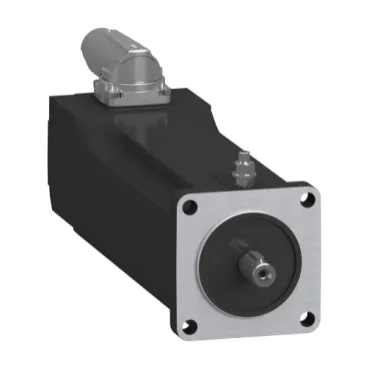
55 mm flange, 181 mm body — what the package gives you
The Schneider Electric SH30552P1AF4100 is a 55 mm flange servo motor with integrated holding brake, from the SH3 short-name family, carrying an absolute single-turn Hiperface DSL encoder on the rear end and terminating in a rotatable right-angle quicklock connector. Mounting is the international standard flange with 5.5 mm holes and a 40 mm centring collar 2 mm deep, so it drops into the standard Lexium servo mounting pattern without an adapter plate.
0.75 N.m nominal, 530 W continuous across the voltage classes
Continuous power is 530 W and nominal torque is 0.75 N.m at 230 V single phase, falling to 0.63 N.m on 400 V and 480 V three phase — the higher mains voltages give more speed headroom (8000 rpm at 400 V, 9000 rpm at 480 V) but the per-amp torque constant stays at 0.59 N.m/A at 120 °C, so the drive's current loop scaling is set once and reused. Peak stall torque is 2.5 N.m across the 115–480 V range, with maximum Irms of 4.8 A and a 3 s peak output current of 4.8 A — enough short-term margin for acceleration and reversals without oversizing the drive, while continuous stall torque settles at 0.71 N.m and continuous stall current at 1.2 A for the thermal envelope. Back EMF is 40 V/krpm at 20 °C and stator winding is 17.4 Ohm with 18.2 mH inductance — the inductance tells the integrator what current-loop bandwidth to expect at a given DC-bus voltage and helps size the output filter on the drive side.
Holding brake, shaft, and the loads it absorbs
The integrated holding brake delivers 0.8 N.m at 10 W pull-in power, sized to hold the rotor — not to stop a moving load — so the safety stop function still has to come from the drive's brake control output, not from relying on the brake to absorb kinetic energy. Shaft is 9 mm diameter with a 20 mm length and parallel key (3 mm key width), so the coupling and pulley selection follow standard small-frame servo practice; maximum radial load is 190 N at 8000 rpm and maximum axial load is 40 N, which is the envelope a belt drive or small pinion must stay inside to avoid premature bearing wear. Cooling is natural convection with a 130 °C copper-hot limit, so the motor is sized for the mount it sits in — a steel plate behind the flange or a heat-sunk housing will pull more continuous torque out of it than an exposed standoff in still air.