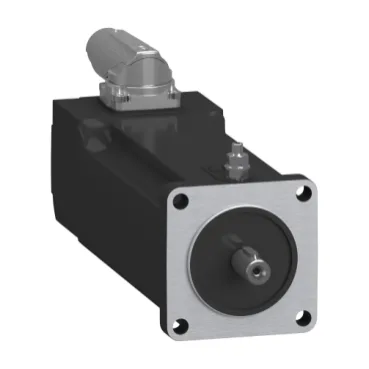
Where this SH3 fits in the machine envelope
SH30552P1BA4100 is the 55 mm flange member of the Schneider Electric SH3 servo line, sized for the 0.4–0.5 kW continuous slot where the previous-generation SH/SH2 frames were specified — a 530 W continuous rating at 400 V three phase and 280 W at 230 V single phase means the same motor can ride either a single-phase drive in a small machine or a three-phase drive in a larger cabinet without changing the mechanics. The 0.63 N.m nominal torque at 400/480 V and 0.75 N.m at 230 V single phase is the figure that drives the gearbox and coupling selection upstream of the driven load.
Speed, torque and current profile across the supply
Nominal speed tracks the bus voltage: 4000 rpm at 230 V single phase, 8000 rpm at 400 V three phase, 9000 rpm at 480 V three phase, with a 9000 rpm mechanical ceiling. The peak stall torque of 2.5 N.m from 115 V to 480 V three phase is the short-duration figure the drive will deliver during acceleration — roughly 4× the 0.71 N.m continuous stall torque, so the sizing exercise should respect the 3-second peak current of 4.8 A rather than the 1.2 A continuous stall current when sizing fuses upstream. The motor electrical constants are stated for thermal planning: 17.4 Ohm stator resistance, 18.2 mH stator inductance, 0.59 N.m/A torque constant at 120 °C copper temperature, and a 40 V/krpm back-EMF constant at 20 °C. With the 130 °C copper hot-spot limit and natural-convection cooling, continuous current is the figure that gates duty — the torque constant is already specified at the 120 °C winding temperature so the constant-power region derates predictably with the ambient.
Feedback, cabling and shaft-side mechanical limits
Feedback is an absolute multiturn Hiperface DSL encoder over a quick-lock rotatable right-angle connector — the DSL link carries power and data on a single cable pair, which is the wiring detail that fixes the drive-end mating connector on the Lexium or PacDrive side and eliminates the separate battery box that older absolute encoders required. The connector is rotatable so the cable exit can be clocked to clear the cabinet wall or the adjacent axis once the motor is bolted down. IP65 is held at both the motor body and the shaft bushing per IEC 60034-5, which covers wet machine rooms and washdown-adjacent areas but is not a food-zone rating — if the line calls for an IP67 or IP69K bushing, this part is not that variant. The parallel-key shaft end at 9 mm × 20 mm with a 3 mm key is the standard small-frame interface for backlash-eliminating zero-backlash couplings and small gear pinions. Shaft loading caps the coupling choice: maximum radial force Fr is 660 N at 1000 rpm, and maximum axial force Fa is 80 N — these scale with speed and the derating curve in the SH3 mounting documentation, so a timing-belt drive pulling higher radial load at 6000 rpm is over the published envelope and a zero-backlash coupling or a helical pinion is the safer mechanical interface.
Sourcing posture for the BOM line
Where a frame change is on the table (for example, moving to a higher-torque SH3 variant in the same family), the 55 mm flange and the Hiperface DSL feedback link are the dimensions that fix the cut-in path. Independent distribution carries the lead against an RFQ for both prototype and production quantities, with current pricing and availability confirmed against the requested quantity and the delivery milestone.