Drop-in modern guts into an old servo bay?
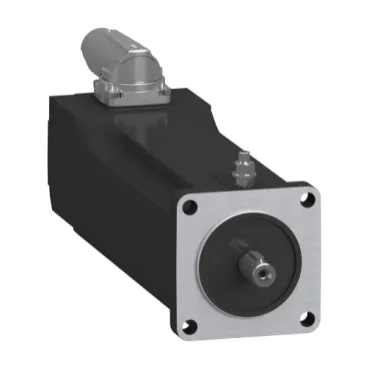
The Schneider Electric SH30552P1BF4100 sits in the SH3 family at a 55 mm flange with a 181 mm body length and a 9 mm parallel-key shaft, so it meets the standard mounting envelope you would expect from a compact AC servo with an integrated holding brake. The centring collar is 40 mm diameter by 2 mm deep with 5.5 mm mounting holes — a footprint that lines up with the international standard flange pattern common on retrofit panels.
What the torque/speed envelope actually means
Nominal torque varies with the supply you drive it from: 0.75 N.m at 230 V single phase, 0.63 N.m at 400 V three phase, and 0.63 N.m at 480 V three phase. Continuous output power follows the same pattern — 280 W at 230 V single phase versus 530 W at both 400 V and 480 V three phase. In other words, the same frame delivers nearly twice the continuous mechanical power when fed from a three-phase bus than from a single-phase 230 V supply, so the panel's mains configuration is part of the sizing decision, not just a wiring detail. Peak stall torque is 2.5 N.m across the 115…480 V three-phase range, against a continuous stall torque of 0.71 N.m — roughly a 3.5× short-term headroom for acceleration and shock loads. The motor's torque constant is 0.59 N.m/A at 120 °C winding temperature, with a 1.2 A continuous stall current and a 4.8 A Irms/3-second peak. That current ceiling is the figure to hand to the drive sizing step, not the headline power number. Nominal speed shifts with supply too: 4000 rpm at 230 V single phase, 8000 rpm at 400 V three phase, and 9000 rpm at 480 V three phase. The stator reads 17.4 Ohm phase resistance with 18.2 mH inductance and a 40 V/krpm back-EMF constant at 20 °C, with copper-hot limit rated at 130 °C. Three motor poles and natural-convection cooling — no integrated fan — mean the thermal margin comes from how the panel builder mounts it, not from forced airflow.
Feedback, sealing, and the shaft-side reality
The feedback is an Absolute multiturn Hiperface DSL encoder — the single-cable digital protocol that pairs with the modern Lexium drive family. For a retrofit where the old resolver cable would otherwise force a re-pull, that single-cable feedback is the migration lever: the motor side uses a quicklock rotatable right-angled connector, so the cable exit angle can be set after the motor is bolted in.
Lifecycle status and how to put it on a BOM
Lifecycle stage is recorded as current production. No official LTB notice or PCN-EOL cross-reference sits on file for this order code, and there is no listed successor in the same footprint — sourcing reality is the standard quoted-to-order channel for active Schneider Electric servo stock, with availability and pricing confirmed against the BOM quantity at RFQ.