Lifecycle and quoting posture
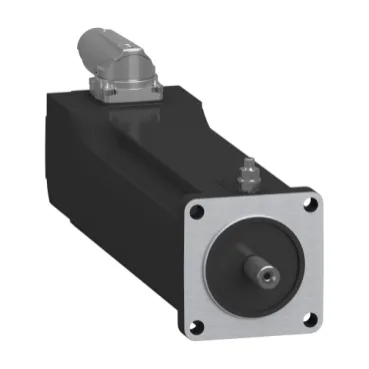
Lifecycle reads current on the SH30553P0BF4000 entry, so the SH3 servo is still in normal production rather than a last-time-buy line — a clean BOM slot for new builds and a straightforward replacement ask when a unit on the floor goes down. The catalog sits it under Servo Motors with Brake (K) with a 55 mm flange and the SH3 device short name, so cross-referencing the sizing reference SH30553P on the quote confirms the family and the matching drive firmware profile.
Power and torque envelope
Continuous output power is rated 680 W at 400 V three phase and 680 W at 480 V three phase, with a 390 W figure at 230 V single phase — the drive must be sized for the three-phase rating to land full continuous torque. Nominal torque sits at 1.1 N.m on the 230 V single-phase supply, dropping to 0.81 N.m at 400 V and 480 V three phase, and peak stall torque reaches 3.5 N.m at 115 to 480 V three phase for the acceleration pulses that decide cycle time on a pick-and-place or indexing axis. Nominal speed scales with the bus — 4000 rpm at 230 V single phase, 8000 rpm at 400 V three phase, and 9000 rpm at 480 V three phase — so the same winding rides three different working points depending on which Schneider drive is feeding it.
Encoder feedback and electrical constants
Position feedback is an absolute multiturn Hiperface DSL encoder — a single-cable digital protocol that drops the second feedback conductor and keeps the wiring through the rotatable quick-lock right-angled connector to one cable run. The torque constant of 0.62 N.m/A at 120 °C and the back EMF constant of 41 V/krpm at 20 °C are the two numbers the drive auto-identify routine needs to lock onto the motor model; stator resistance of 10.4 Ohm and stator inductance of 13.02 mH shape the current-loop bandwidth above that. Continuous stall current is 1.7 A against a 6.5 A Irms peak ceiling, which is the headroom the drive's torque-limit clamp must respect during acceleration pulses.
Mechanical fit and ingress
The motor mounts on an international standard flange with a 55 mm motor flange size, 5.5 mm mounting holes, a 40 mm centring collar at 2 mm depth, and an overall length of 203 mm — that's the envelope to clear inside the machine frame. The shaft is a 9 mm diameter smooth shaft at 20 mm long, with a maximum radial force of 710 N at 1000 rpm and maximum axial force of 80 N — the bearing-loading budget for any belt, gear or coupling on the shaft end. Ingress protection is IP65 on the motor body and IP54 on the shaft bushing without a shaft seal ring, both per IEC 60034-5; the IP65 rating covers cabinet-internal washdown and dusty cell environments, while the IP54 shaft side warns against direct spray or submerged duty where a sealed variant would be required.