Sizing the motor to the drive's torque and speed envelope
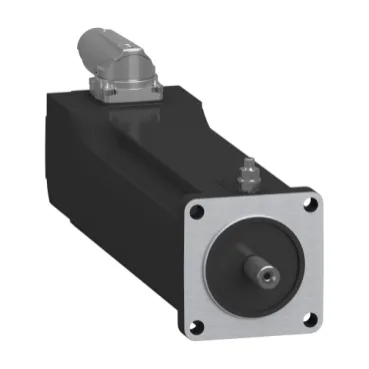
The SH30553P0BF4100 sits in Schneider Electric's SH3 servo family and carries the SH30553P sizing reference, so an SH3-rated drive or Lexium servo drive from the same generation will accept it on the same feedback protocol and power chain. Continuous power is 680 W, with the same 680 W nominal output at both 400 V three phase and 480 V three phase, dropping to 390 W on 230 V single phase, which is the rail the drive cabinet has to deliver. Nominal torque scales with the supply: 1.1 N·m on 230 V single phase against 0.81 N·m on either 400 V or 480 V three phase. Peak stall torque reaches 3.5 N·m across the 115–480 V three-phase window, meaning the drive's current limit must be set above the 6.5 A Irms / 6.5 A 3 s peak rating to use that peak in the acceleration profile without saturating the controller. Maximum mechanical speed is 9000 rpm, reached on 480 V three phase. The 4000 rpm figure on 230 V single phase is the field-weakening ceiling on that supply, not a separate model variant — drives that push the speed command past the rail-limited speed will simply roll off torque per the motor's back-EMF constant of 41 V/krpm at 20 °C.
Brake, feedback, and the wiring that lands on the cabinet
The integrated holding brake delivers 0.8 N·m of holding torque with a 10 W pull-in coil, sized to lock a vertical or incline axis on power loss without oversizing the cabinet's 24 V brake supply. The encoder is an absolute multiturn Hiperface DSL unit, which means the single-cable quicklock rotatable right-angled connector carries both power and feedback back to the drive — count one cable, not two, in the panel gland plate layout.
Mechanical envelope, sealing, and panel-side fit
IP65 on both the motor body and the shaft bushing per IEC 60034-5 means the housing tolerates hose-down and dusty cell environments, but the rating applies to the mated connector, not the bare shaft — the through-bore at the cable entry is the wet-end barrier, so the sealing washer on the gland has to seat on install. Cooling is natural convection, so derating begins above the 130 °C copper-hot thermal limit; forced-air or a heatsink is not part of the catalogue configuration.
Drive-matching constants for the commissioning engineer
Torque constant is 0.62 N.m/A at 120 °C, paired with stator resistance 10.4 Ohm and stator inductance 13.02 mH — three figures that drop directly into the drive's current-loop tuning. Continuous stall torque is 1.05 N·m at 1.7 A continuous stall current, the figure that decides whether the motor holds a static load without tripping the drive's I²T thermal model.
Lifecycle posture and how this part is quoted
Sourcing runs through independent distribution against an RFQ — production quantities, lead time, and current pricing come back with the quote, and the order is filled against the BOM position rather than off the shelf.