Speed-torque envelope across supply voltages
The SH30553P12A2100: The motor delivers 6000 rpm nominal at both 400 V three-phase and 480 V three-phase, with a nominal torque of 7.17 lbf.in (0.81 N.m) at those voltages. On single-phase 230 V it runs at 4000 rpm with 9.7 lbf.in (1.1 N.m); on 115 V single-phase it drops to 2000 rpm and 10.001 lbf.in (1.13 N.m). Continuous power is 680 W, but nominal output power varies by supply: 240 W at 115 V single-phase, 460 W at 230 V single-phase, 880 W at 400 V three-phase, and 970 W at 480 V three-phase. The peak stall torque reaches 31.0 lbf.in (3.5 N.m) across the 115–480 V three-phase range — useful for short-duration acceleration events. Continuous stall torque is 9.29 lbf.in (1.05 N.m) at 115–480 V three-phase, so the motor holds rated torque at zero speed without overheating, assuming natural convection cooling (the specified cooling type).
Encoder, feedback, and mechanical interface
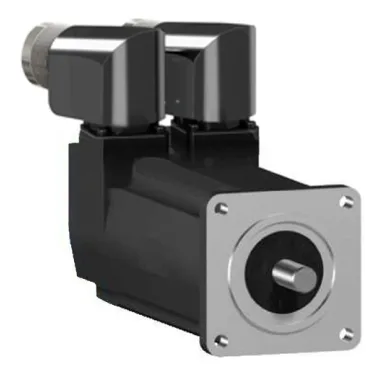
The encoder is an absolute multiturn SinCos Hiperface type — this gives position feedback on power-up without a homing cycle, which matters for applications where the axis position must be known immediately after a power loss or cycle. The electrical connection uses a rotatable right-angled connector, so the cable exit angle can be adjusted in the field to fit tight cabinet layouts. IP65 protection on both the motor body and the shaft bushing (per IEC 60034-5) means it handles washdown environments — food processing, packaging, or any line where hosing down the machine is routine. Mounting is via an international standard flange with a 55 mm flange size and a 40 mm centring collar. The shaft is 9 mm diameter, 20 mm long, with a parallel key and 3 mm key width. Maximum radial force at the shaft is 190 N at 8000 rpm, rising to 390 N at 1000 rpm — derate the overhung load if running at lower speeds.
Electrical parameters for drive tuning
Stator resistance is 10.4 Ohm and stator inductance is 13.02 mH — these are the values the servo drive needs for its current-loop tuning and for setting the field-weakening breakpoint. The torque constant is 0.62 N.m/A at 248 °F (120 °C), and the back EMF constant is 41 V/krpm at 68 °F (20 °C). Maximum RMS current is 6.5 A, and the 3-second peak output current is also 6.5 A — so the motor's thermal limit and the drive's peak current capability are matched at that figure. The motor has 3 poles.