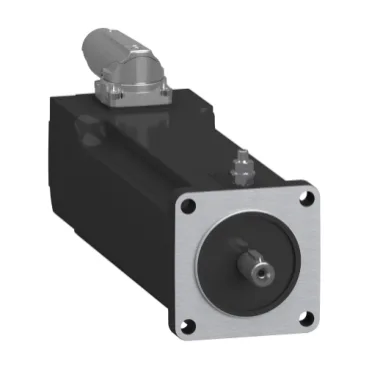
Defining the SH30553P1AA4000 motor
The Schneider Electric SH30553P1AA4000 is a brushless AC servo motor from the SH3 family, built around a 55 mm international-standard flange and measuring 176.5 mm long with a 9 mm shaft. Feedback comes from an absolute single-turn Hiperface DSL encoder wired through a rotatable right-angled quicklock connector, and the rotor carries no holding brake.
Torque, speed, and power envelope
Continuous output is 680 W with 1.1 N.m nominal torque at 4000 rpm on a 230 V single-phase supply; the same 680 W figure holds at 400 V three-phase and 480 V three-phase, though nominal torque drops to 0.81 N.m at the higher line voltages. Peak stall torque reaches 3.5 N.m from 115 V to 480 V three-phase, with 6.5 A peak output current for 3 s — the margin the drive uses to accelerate and decelerate inertial loads without stalling. Continuous stall torque is 1.05 N.m at 1.7 A across the same 115–480 V three-phase range, so the motor holds position under steady load without exceeding its thermal envelope. Maximum mechanical speed is 9000 rpm; the back-EMF constant is 41 V/krpm at 20 °C, which sets the bus-voltage headroom required at top speed.
Drive-matching electrical parameters
Winding resistance is 10.4 Ohm and stator inductance 13.02 mH; the torque constant is 0.62 N.m/A at 120 °C — these are the values the servo drive's auto-tuning routine reads to set current-loop gains.
Mechanical envelope and environmental ratings
The motor body carries an IP65 rating per IEC 60034-5, with the shaft bushing at IP54 when no shaft seal is fitted — adequate for cabinet interiors and light splash zones, but the shaft side needs a seal if coolant or cutting fluid is present. Cooling is natural convection with no integrated fan, so derating curves in the SH3 manual apply when the motor is mounted inside a sealed enclosure or stacked above another heat source. Shaft loading limits are 660 N radial at 1000 rpm and 80 N axial, with the parallel key cut to a 3 mm width on a 20 mm shaft engagement — the coupling and pulley design must respect these figures to avoid bearing wear.