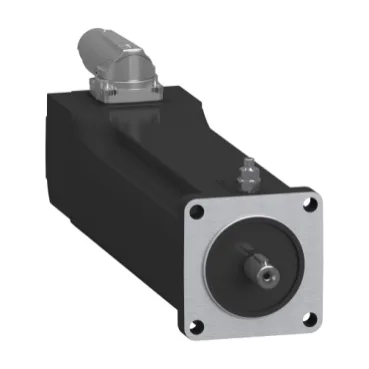
What the SH30553P1BF4000 delivers across the three supply rails
The Schneider SH30553P1BF4000 is a 55 mm flange AC servo from the SH3 family, sized by reference SH30553P, carrying an absolute multiturn Hiperface DSL encoder and an integral holding brake on a 9 mm keyed shaft. Continuous output power lands at 390 W when fed from 230 V single phase and rises to 680 W on either 400 V three phase or 480 V three phase; nominal torque follows the same split — 1.1 N.m at 230 V single phase versus 0.81 N.m on the 400 V and 480 V three-phase rails — so the same frame pulls noticeably more torque once it is wired to a three-phase supply. Nominal speed tracks the supply in a similar way, climbing from 4000 rpm at 230 V single phase to 8000 rpm at 400 V three phase and 9000 rpm at 480 V three phase, while peak stall torque reaches 3.5 N.m across the 115 to 480 V three-phase envelope and continuous stall torque holds at 1.05 N.m over the same span. Continuous power is listed at 680 W, matching the 400 V and 480 V three-phase figures of — the single-phase 230 V rail delivers roughly 57 percent of that figure at the same stator, and that gap is the rating that decides whether the drive upstream has to be a three-phase unit.
Stator constants and how they set the upstream drive
Stator winding is 10.4 Ohm with 13.02 mH of inductance, and the 3s peak output current is 6.5 A, identical to the maximum Irms rating — the drive has to deliver 6.5 A peak per phase with the bus voltage headroom to force that current through the inductive winding at the chosen switching frequency. Continuous stall current is 1.7 A, which against the 0.62 N.m/A torque constant reconciles to the 1.05 N.m continuous stall torque figure on; above that, the thermal model drives the current back to maintain the 130 degrees Celsius copper hot-spot limit.
Mechanical envelope and where it drops into the machine
The motor mounts on an international standard 55 mm flange with a 40 mm centring collar at 2 mm depth, and four 5.5 mm mounting holes — that flange size places it in the SH3 small-frame band, and the centring collar depth is the dimension the mating gearbox or pulley has to clear. Shaft end is a parallel key with 9 mm diameter, 20 mm usable length, and a 3 mm key — the maximum radial load is 710 N at 1000 rpm and the maximum axial load is 80 N, so belt drives and coupled pumps have to be sized against the radial figure at the operating speed, not just at stall.
Encoder, brake and the IP rating that lets it sit near the process
Encoder is absolute multiturn Hiperface DSL, on a quicklock rotatable right-angled connector — the single-cable DSL link carries power and data on the same pair, which removes the encoder cable from the cable tray and shortens the commissioning loop because the drive reads absolute position from power-on without a homing run. Holding brake torque is 0.8 N.m, set against the 1.1 N.m nominal and 3.5 N.m peak figures on and — the brake is sized to hold the load at standstill, not to stop it dynamically, and the 10 W pull-in power on is the figure the cabinet 24 V supply or the drive's brake output has to deliver. Cooling is natural convection and the IP rating splits along the body: IP65 for the motor housing per IEC 60034-5 and IP54 at the shaft bushing when no shaft seal ring is fitted — the seal-ring variant is the call a washdown or food-grade line makes, and the differential tells the integrator which gland or shaft seal to stock with the spare.
Sourcing posture for the SH30553P1BF4000
Lifecycle stage is current per, the SH3 series stays in production, and no official LTB or cross-reference successor is on the ledger for this code — the right sourcing posture is to quote the motor against the BOM line and confirm quantity availability at RFQ, rather than treat it as a stocking-shelf line item.