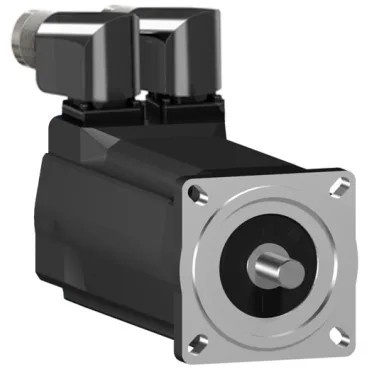
Motor ratings and what they mean for the drive train
The SH30701P02F2200 is a three-phase servo motor with a continuous power rating of 690 W and a nominal speed that depends on the supply voltage: 1500 rpm at 115 V single phase, 3000 rpm at 230 V single phase, 6000 rpm at 400 V three phase, and 7200 rpm at 480 V three phase. That speed range means the motor can be paired with a drive that matches the line voltage and the load speed requirement — the 6000 rpm at 400 V three phase is the typical industrial choice for high-speed spindles or indexing applications. Nominal torque is 1.4 N.m at 115 V and 230 V single phase, dropping to 1.1 N.m at 400 V and 480 V three phase. The continuous stall torque is 1.25 N.m across the 115–480 V three-phase range, which is the torque the motor can hold at zero speed without overheating. The holding brake delivers 3 N.m of holding torque — this is the static torque that keeps the load in position when the drive is off, not the dynamic braking torque during deceleration. For a vertical axis or a tool-change spindle, that brake rating is the number that determines whether the load stays put.
Encoder, feedback, and integration constraints
The motor carries an absolute multiturn SinCos Hiperface encoder. That means the drive gets position and speed feedback with multiturn resolution — no need for a homing cycle on power-up, which saves time on multi-axis machines. The Hiperface protocol is common on Schneider Lexium drives, so the pairing is straightforward. The electrical connection is a straight connector (rotatable right-angled connector also available per the spec), which gives some flexibility in cable routing inside the cabinet. The IP65 motor and IP67 housing ratings per IEC 60034-5 mean the motor body and shaft bushing are protected against dust ingress and water jets — suitable for washdown areas or outdoor installation.