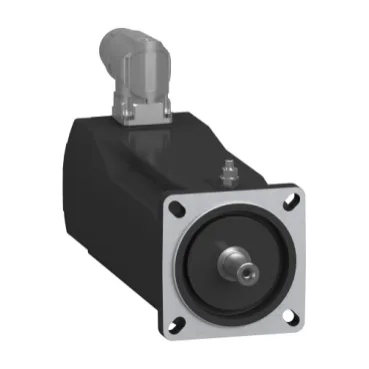
Frame and mounting — 70 mm flange, 180 mm body
The SH30701P0BF4100 is a 70 mm flange-size servo motor with a 180 mm body length, mounting to standard international flange patterns per the SH3 series sizing reference. The smooth 11 mm shaft (23 mm engagement length) accepts a clamping hub or collet coupling — no keyway, so the coupling bore must match the shaft diameter precisely. Two connector options are supplied: a straight connector and a quicklock rotatable right-angled connector, letting the cable exit orientation be adjusted in the field without re-termination.
Speed and torque across supply voltages
This motor delivers different speed and torque depending on the supply: at 230 V single-phase it runs 3000 rpm with 1.4 N.m nominal torque; at 400 V three-phase it reaches 6000 rpm at 1.1 N.m; at 480 V three-phase it hits 7200 rpm at 1.1 N.m. Continuous power is 690 W at 400/480 V three-phase, dropping to 370 W at 230 V single-phase — the three-phase supply is where this motor delivers its full rated output. Continuous stall torque is 1.25 N.m across the 115-480 V three-phase range, with a peak stall torque of 3.5 N.m for short-term acceleration or overload events.
Encoder and feedback — absolute multiturn Hiperface DSL
This encoder protocol is native to Schneider Lexium drives and many third-party servo drives supporting Hiperface DSL — confirm drive compatibility before specifying.
Brake and mechanical limits
The integrated holding brake delivers 3 N.m holding torque and requires 7 W pull-in power to release — the brake holds the vertical axis at power-off without external mechanical locks. Bearing load limits are 900 N radial force at 1000 rpm and 160 N axial force — stay within these for belt/pulley or direct-coupled loads to avoid premature bearing wear.
Thermal and environmental rating
Cooling is by natural convection — no integrated fan, so the motor relies on the mounting surface and ambient airflow for heat dissipation; derate if enclosed in a confined space. Stator resistance is 10.4 Ohm and stator inductance is 21.3 mH — these influence the drive's current-loop tuning and I²R thermal losses at sustained load.