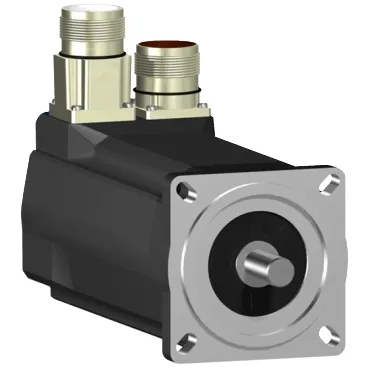
Motor ratings across supply voltages
The SH30703M01A1200 delivers 3000 rpm nominal speed at 400 V three-phase supply, and 3600 rpm at 480 V three-phase — the speed scales linearly with input voltage above the motor's base rating. On single-phase 115 V it runs 750 rpm; on 230 V single-phase it reaches 1500 rpm. Nominal torque holds at 23.28 lbf.in (2.63 N.m) on both 400 V and 480 V three-phase supplies, but drops to 26.99 lbf.in (3.05 N.m) on 115 V single-phase and 26.11 lbf.in (2.95 N.m) on 230 V single-phase — the torque curve is flattest on three-phase where the motor is designed to operate. Continuous power output is 830 W, with nominal output power varying by supply: 240 W on 115 V single-phase, 460 W on 230 V single-phase, 880 W on 400 V three-phase, and 1030 W on 480 V three-phase. The 830 W figure is the motor's thermal continuous rating; actual shaft power depends on the drive's voltage and current limit.
Feedback and environmental sealing
The encoder is an absolute single-turn SinCos Hiperface type — it reports position at power-up without a homing sequence, which simplifies commissioning on multi-axis machines where the controller expects absolute feedback on each axis. IP65 rating on the motor body and shaft bushing per IEC 60034-5, with IP67 on the housing — the motor withstands washdown spray and condensation common in food-and-beverage or washdown packaging lines. The shaft bushing seal is the wet-end barrier; the housing seal is secondary.
Mounting and shaft interface
Motor flange size is 70 mm (2.8 in) with a centring collar diameter of 60 mm (2.4 in) and a centring collar depth of 2.5 mm (0.10 in) — this is the standard IEC 72-1 flange pattern for frame size 70, so it bolts directly to matching gearboxes and mounting brackets without adaptor plates. Smooth shaft, 14 mm diameter, 30 mm shaft length, with a 5 mm keyway — no key fitted as standard, so the coupling or pulley must be clamped or keyed separately. The smooth shaft allows the end user to fit the correct key for their hub. Electrical connection options include a rotatable right-angled connector and a straight connector — the right-angled version saves radial space in tight cable trays; the straight connector suits axial cable exit. Both are field-rotatable on the motor housing.