Active production — what that means for your BOM line
The SH30703M02A2200: Sourced through authorized distribution channels against an RFQ.
Speed-torque curves that decide the drive match
This motor delivers different nominal speeds depending on the supply: 750 rpm at 115 V single-phase, 1500 rpm at 230 V single-phase, 3000 rpm at 400 V three-phase, and 3600 rpm at 480 V three-phase. The nominal torque shifts accordingly — 3.05 Nm at 115 V, 2.95 Nm at 230 V, and 2.63 Nm at both 400 V and 480 V three-phase. Continuous output power also varies by supply: 240 W at 115 V single-phase, 460 W at 230 V single-phase, 880 W at 400 V three-phase, and 1030 W at 480 V three-phase. The continuous stall torque across the three-phase range is 2.94 Nm at 2.1 A continuous stall current. Peak stall torque hits 11.3 Nm across the 115-480 V three-phase range — useful for short-duration acceleration or overcoming breakaway friction. The torque constant is 1.4 Nm/A at 120 °C, and the back EMF constant is 95 V/krpm at 20 °C.
Encoder and feedback — the drive compatibility gate
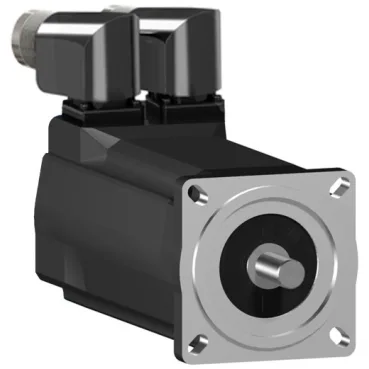
Fitted with an absolute multiturn SinCos Hiperface encoder — this is a high-resolution feedback standard common on Schneider and third-party servo drives. The multiturn count tracks absolute position over multiple shaft revolutions, so the drive knows the load position immediately on power-up without needing a homing sequence. The electrical connection uses a straight connector, with a rotatable right-angled connector option — gives flexibility for tight cable routing in the cabinet or on the machine frame.
Sealing and mounting for the real floor
IP65 on the motor body and shaft bushing, IP67 on the housing per IEC 60034-5 — the motor survives washdown and airborne dust. The shaft is smooth (no keyway), 14 mm diameter, 30 mm shaft length, with a 5 mm key width. The flange is the international standard 70 mm size with a 60 mm centring collar and 2.5 mm centring collar depth.