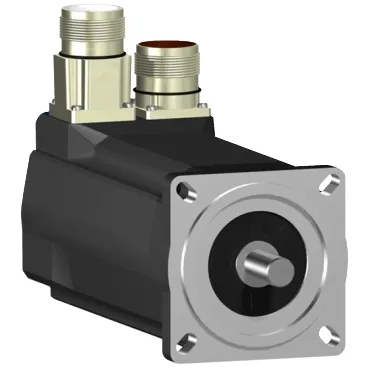
830 W servo motor, three-phase, without brake
The SH30703M12A1200 is an SH3-series servo motor rated for 830 W continuous power on a three-phase supply. It delivers 3000 rpm nominal at 400 V three-phase, or 3600 rpm at 480 V three-phase. The motor is built without a holding brake, so the load must be held externally or by the drive's holding torque at standstill. Nominal torque varies with supply: 3.05 Nm at 115 V single-phase, 2.95 Nm at 230 V single-phase, and 2.63 Nm at both 400 V and 480 V three-phase. Peak stall torque reaches 11.3 Nm across the 115–480 V three-phase range, giving a 4.3× torque overload margin for acceleration and deceleration cycles. The encoder is an absolute multiturn SinCos Hiperface type, which retains position after power loss and eliminates the need for a homing sequence on restart. This matters for applications where the machine must resume operation without a reference move.
IP65/IP67, natural convection, 70 mm flange
The motor carries IP65 protection on the motor body and shaft bushing, with IP67 on the housing, conforming to IEC 60034-5. This makes it suitable for washdown environments and dusty production areas — the connector O-ring and shaft seal are the wet-end barriers. Cooling is by natural convection only — no external fan or forced air is required. The continuous stall current is 2.1 A, and the maximum RMS current is 8.7 A. The stator resistance is 10.7 Ohm with an inductance of 27.65 mH, which sets the electrical time constant the drive must handle. Mounting uses an international standard flange with a 70 mm flange size, a 60 mm centring collar diameter, and 5.5 mm mounting holes. The shaft is 14 mm diameter with a parallel key, 30 mm shaft length, and 5 mm key width. The centring collar depth is 2.5 mm.
The sizing reference is SH30703M, and the device short name is SH3. The motor is supplied as a single unit per package. The electrical connection options include a rotatable right-angle connector or a straight connector, which must be specified at order to match the cable exit direction in the installation.