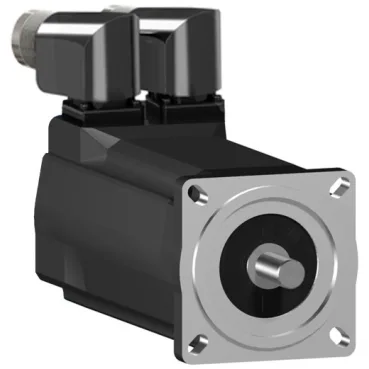
Frame size and mounting — 70 mm flange, 220 mm body
The SH30703M12A2100: The motor flange measures 70 mm across, with a centring collar diameter of 60 mm and a depth of 2.5 mm — this is the standard IM B5 flange pattern for this power class, so it bolts directly onto common gearboxes and machine frames without adaptor plates. Overall length is 220 mm from the mounting face to the connector end, with a 14 mm shaft diameter and a 30 mm shaft length that carries a parallel key (5 mm key width).
Speed and torque across supply voltages
This is a three-phase servo motor, but its nominal speed and torque shift depending on what voltage you feed it. On a 400 V three-phase line it spins 3000 rpm and delivers 2.63 N·m; on 480 V three-phase it reaches 3600 rpm at the same torque. Drop to 230 V single-phase and you get 1500 rpm at 2.95 N·m; at 115 V single-phase it's 750 rpm at 3.05 N·m. The continuous power rating follows the same curve: 880 W at 400 V, 1030 W at 480 V, 460 W at 230 V, and 240 W at 115 V. If you're wiring this into a 480 V line, you get the full 1 kW output; on a 230 V line you're limited to about half that.
Encoder and feedback — absolute multiturn SinCos Hiperface
The encoder is an absolute multiturn SinCos Hiperface type — that means it reports position and number of revolutions even after a power loss, no homing cycle needed on startup. The SinCos analog track gives high-resolution speed feedback for smooth velocity loops.
Cooling and environmental protection
Cooling is natural convection — no fan, so the motor relies on surface area and ambient airflow.
Electrical parameters for drive tuning
Stator resistance is 10.7 Ω and inductance is 27.65 mH — these set the electrical time constant and influence the current-loop bandwidth you can achieve with the drive. The torque constant is 1.4 N·m/A at 120°C copper temperature, and the back EMF constant is 95 V/krpm at 20°C, so at 3000 rpm the motor generates 285 V line-to-line back EMF. Maximum continuous current is 8.7 A, and the peak current for 3 seconds is also 8.7 A — this motor doesn't have a separate peak rating above continuous, so any overload beyond 8.7 A must be short enough to stay within the thermal limit.
Mechanical load limits — radial and axial forces
The maximum radial force on the shaft depends on speed: 730 N at 1000 rpm, dropping to 400 N at 6000 rpm. Maximum axial force is 80 N. If you're driving a belt or a direct-coupled load, check that the belt tension or coupling misalignment stays under these limits at your operating speed.