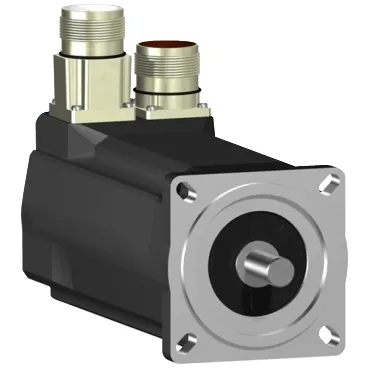
830 W continuous, 3 N·m brake — where this SH3 fits
The SH30703M12F1000 is a Schneider Electric SH3-series servo motor delivering 830 W continuous power from a 70 mm flange frame, with a holding brake rated 3 N·m that locks the shaft when power is removed. The absolute multiturn SinCos Hiperface encoder means this motor remembers its position after a power cycle — no homing routine needed on restart, which saves time on indexing axes or gantry systems where the load stays coupled. Nominal speed climbs with supply voltage: 750 rpm on 115 V single-phase, 1500 rpm on 230 V single-phase, 3000 rpm on 400 V three-phase, and 3600 rpm on 480 V three-phase. The three-phase 400 V or 480 V feed is what unlocks the full 880 W or 1030 W nominal output power.
Torque profile across the voltage range
Nominal torque holds fairly flat across voltages: 3.05 N·m at 115 V single-phase, 2.95 N·m at 230 V single-phase, and 2.63 N·m at both 400 V and 480 V three-phase. The continuous stall torque sits at 2.94 N·m across the 115…480 V three-phase range. Peak stall torque reaches 11.3 N·m on three-phase supplies — about 3.8× the continuous rating, which gives headroom for acceleration through a cut or breakaway from a stuck load without tripping the drive. The torque constant is 1.4 N·m/A at 120 °C copper temperature, meaning the drive current needed to hold a given torque is predictable once the motor is thermally stable.
Mounting, shaft, and connector — what the flange tells you
The motor mounts on an international standard flange with a 70 mm square face, a 60 mm centring collar, and four 5.5 mm mounting holes on a 2.8 in (70 mm) bolt circle. The centring collar depth is 2.5 mm — shallow enough that the pilot register engages before the bolts bottom out. The shaft is 14 mm diameter, 30 mm long, with a parallel key 5 mm wide and 0.2 in (5 mm) keyway depth. Overall body length is 254 mm. Two connector options are listed — a rotatable right-angled connector and a straight connector. The rotatable version helps route the cable in tight cabinets without bending the cable jacket past its minimum radius.
IP rating, cooling, and bearing loads
The motor body carries IP65 protection per IEC 60034-5, but the shaft bushing without a shaft seal ring drops to IP54. For washdown zones, specify the shaft seal ring option to keep the IP65 rating at the shaft exit. Cooling is natural convection — no external fan, so the continuous ratings assume free air circulation around the finned housing. Forced ventilation may be needed if the motor is enclosed in a non-ventilated bell housing. Maximum radial force Fr is 730 N at 1000 rpm, dropping to 400 N at 6000 rpm. Maximum axial force Fa is 80 N. These set the belt-tension or coupling-load limits — exceed them and bearing life shortens fast.
Electrical parameters and thermal limits
Stator resistance is 10.7 Ω and stator inductance is 76.85 mH. These values affect the drive's current-loop tuning — expect a lower bandwidth limit on the current regulator compared to a lower-inductance motor. Continuous stall current is 2.1 A; maximum current Irms is 8.7 A. The back EMF constant is 95 V/krpm at 20 °C, so at 3000 rpm the motor generates 285 V back EMF — the drive's DC bus must stay above that to maintain current control. Maximum mechanical speed is 8000 rpm, but the nominal torque and power curves are rated well below that — the bearings and rotor balance are the limit, not the windings. Hot-spot copper temperature is rated 130 °C. The torque constant is specified at 120 °C copper, so the motor can run at full rated torque continuously up to that winding temperature.
Lifecycle and sourcing — current production, quoted to order
The sizing reference SH30703M ties this motor to the SH3 family, so replacement or spare units follow the same mounting and encoder interface — no need to re-engineer the mechanical fit if swapping within the same frame size.