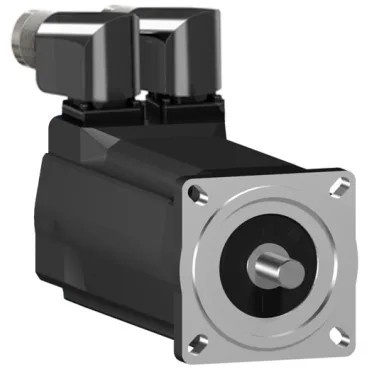
830 W servo with holding brake for vertical-axis hold
The SH30703M12F2200: The absolute multiturn SinCos Hiperface encoder eliminates the need for a homing sequence on power-up; the drive reads the exact rotor position and load position from the encoder's multiturn count, so the machine resumes the last known position after a power cycle. Motor flange size is 70 mm with a 60 mm centring collar and 5.5 mm mounting holes — standard IEC metric pattern, mates with the matching gearbox or machine frame without adapter plates.
Torque-speed envelope across supply voltages
Nominal torque varies with supply: 3.05 N.m at 115 V single-phase, 2.95 N.m at 230 V single-phase, and 2.63 N.m at 400 V or 480 V three-phase. The continuous stall torque is 2.94 N.m across the 115–480 V three-phase range, so the motor delivers consistent low-speed torque regardless of line voltage. Peak stall torque reaches 11.3 N.m for acceleration bursts — roughly 3.8× the continuous rating — which handles quick index moves or overcoming static friction on a stopped axis. Nominal speed depends on the drive supply: 750 rpm at 115 V single-phase, 1500 rpm at 230 V single-phase, 3000 rpm at 400 V three-phase, and 3600 rpm at 480 V three-phase. Maximum mechanical speed is 8000 rpm, so the rotor and bearings are built for high-speed spindle applications if the drive provides the voltage headroom.
Electrical parameters for drive tuning and thermal budget
Stator resistance is 10.7 Ω and inductance is 76.85 mH — a relatively inductive winding that limits current ripple at moderate PWM frequencies. The torque constant is 1.4 N.m/A at 120 °C copper temperature, and the back EMF constant is 95 V/krpm at 20 °C. Cooling is natural convection — no fan, so the thermal time constant is longer and the motor relies on the flange and frame to dissipate heat. The hot-spot copper temperature limit is 130 °C.
IP65/IP67 sealing and mechanical interface
IP65 on the motor body and shaft bushing, IP67 on the housing per IEC 60034-5 — the motor withstands hose-down cleaning and temporary submersion. The shaft seal is the wet-end barrier; the connector interface relies on the mating cordset's O-ring. Shaft diameter is 14 mm with a parallel key, shaft length 30 mm, and key width 5 mm. Maximum radial force at the shaft is 730 N at 1000 rpm, derating to 400 N at 6000 rpm. Maximum axial force is 80 N — the bearing set handles moderate thrust, but a separate thrust bearing is needed for high-axial-load applications like leadscrew drives. Electrical connection options include a straight connector and a rotatable right-angled connector — the right-angle variant helps in tight cable-egress spaces where the straight connector would interfere with the machine frame.