Supply voltage drives the speed and torque you get
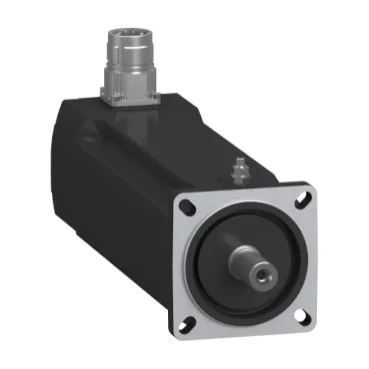
The SH30703P0AA3100: This SH3 servo motor is a three-phase design, but its performance depends on the supply you feed it. On 230 V single-phase the nominal speed is 3000 rpm; step up to 400 V three-phase and it reaches 6000 rpm; at 480 V three-phase it hits 7200 rpm. The nominal torque follows the same pattern: 2.8 N·m at 230 V, dropping to 2.1 N·m at both 400 V and 480 V. Continuous power is 1330 W at 400/480 V, with the nominal output power rated 830 W on 230 V single-phase. If your line voltage is fixed at 230 V single-phase, you lose about 38% of the continuous power compared to a three-phase feed — plan the motor selection around the actual supply, not the datasheet maximum.
Encoder and feedback — absolute single-turn Hiperface DSL
The motor carries an absolute single-turn Hiperface DSL encoder. That means position is known immediately on power-up without a homing move — useful for applications where the axis must resume from the last commanded position after a power cycle. Single-turn limits the absolute range to one revolution; multi-turn applications need a different encoder option. The electrical connection uses a quicklock straight connector. The connector is straight, not angled, so account for cable bend radius in the cable tray or drag chain layout.
IP65 and mechanical limits for the mounting engineer
Both the motor body and the shaft bushing carry IP65 per IEC 60034-5. The motor flange is 70 mm (2.8 in) with a 60 mm centring collar and 5.5 mm mounting holes. Maximum radial force at 1000 rpm is 1050 N; maximum axial force is 160 N. These limits govern bearing life — overshoot them and the encoder alignment drifts or the bearings fail early. Smooth shaft, 14 mm diameter, 30 mm shaft length. No keyway — the coupling or pulley must clamp onto the smooth shaft. Maximum mechanical speed is 8000 rpm, so the 7200 rpm at 480 V stays within the safe envelope.
Stall torque and current — what the drive sees
Continuous stall torque is 2.94 N·m at 115–480 V three-phase, with a continuous stall current of 4.1 A. Peak stall torque reaches 11.3 N·m at the same voltage range, drawing up to 17 A maximum current. The torque constant is 0.72 N·m/A at 120 °C copper temperature. Stator resistance is 2.7 Ω and inductance 14.6 mH. These values set the electrical time constant and influence the servo drive's tuning parameters — expect a longer current rise time than a low-inductance motor, which may limit bandwidth in high-dynamic applications.