Speed-torque envelope and supply-voltage dependency
The SH31001M02F1000: This SH3-series motor delivers nominal speeds that shift with the supply: 625 rpm at 115 V single-phase, 1250 rpm at 230 V single-phase, 2500 rpm at 400 V three-phase, and 3000 rpm at 480 V three-phase. The nominal torque also varies — 2.52 Nm at both 400 V and 480 V three-phase, dropping to 2.8 Nm at 115 V single-phase. Continuous power is 660 W, and the continuous stall torque is 2.94 Nm across the 115–480 V three-phase range. The peak stall torque reaches 9.6 Nm at 115–480 V three-phase, giving a short-term overload margin for acceleration or overcoming static friction.
Brake and encoder — what they mean for the application
Feedback comes from an absolute multiturn SinCos Hiperface encoder. This encoder type reports position on power-up without a homing move, which saves cycle time on machines that power-cycle between batches. The multiturn count tracks revolutions beyond one turn, so the controller knows the absolute position even after multiple shaft rotations.
Mounting, shaft, and environmental sealing
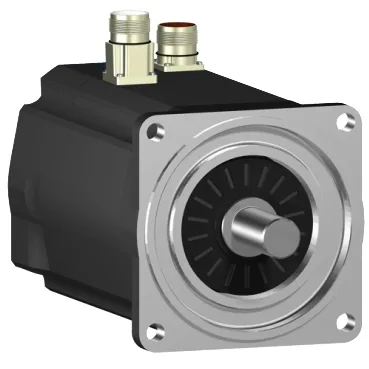
The motor uses an international standard flange with a 100 mm (3.9 in) flange size and a 95 mm centring collar. The shaft is 19 mm diameter, smooth (no keyway), so the coupling or pulley must use a clamping hub — no key to transmit torque. Shaft length is 40 mm (1.6 in) with a 6 mm key width. IP protection depends on the shaft seal: IP54 with the shaft bushing and no shaft seal ring, or IP65 with the shaft bushing and seal ring fitted. In a washdown or dust-prone environment, specify the IP65 variant. The motor is cooled by natural convection — no fan, so mounting must allow free airflow around the housing.
Electrical parameters and drive matching
Stator resistance is 13.9 Ω and inductance is 34.7 mH. The torque constant is 1.63 Nm/A at 120 °C copper temperature, and the back-EMF constant is 115 V/krpm at 20 °C. The maximum continuous current (Irms) is 6.3 A, with a 3-second peak of 6.3 A. The motor has 4 poles. The electrical connection uses a straight connector. Maximum radial force at the shaft is 900 N at 1000 rpm, derating to 530 N at 5000 rpm; maximum axial force is 160 N. These limits govern the allowable belt tension or direct-coupling misalignment.