Motor ratings and the voltage-speed trade-off
The SH31001M11A2100 delivers 660 W continuous power, but the nominal speed and torque depend on the supply voltage you feed it. On 400 V three-phase you get 2500 rpm and 2.52 Nm; step up to 480 V three-phase and it runs 3000 rpm at the same 2.52 Nm. On single-phase 115 V it drops to 625 rpm and 2.8 Nm, while 230 V single-phase gives 1250 rpm at 2.71 Nm. The continuous stall torque — the torque available at zero speed for holding or positioning — is 2.94 Nm across all voltage configurations. Peak stall torque hits 9.6 Nm, which covers acceleration and short-duration overloads.
Encoder feedback and environmental sealing
This motor carries an absolute single-turn SinCos Hiperface encoder. That means you get position feedback at power-up without a homing cycle — useful on axes where the machine references to a fixed home on every start. The single-turn range covers one revolution; for multi-turn applications you would need a different encoder variant. The IP65 rating on both the motor body and shaft bushing means it handles washdown and dust ingress on the line. No holding brake on this variant — if your vertical axis needs a brake to hold position at power-off, look at the SH3 with brake option.
Mounting, cooling, and mechanical limits
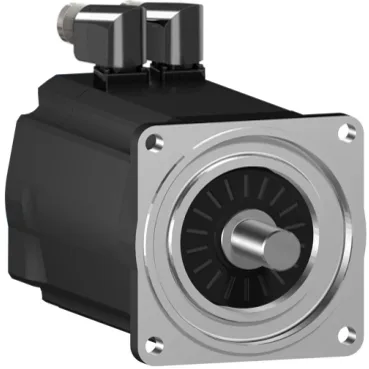
The motor mounts on an international standard flange with a 100 mm flange size and a 95 mm centring collar. The shaft is 19 mm diameter with a parallel key, 40 mm length. Cooling is natural convection — no fan, so the thermal budget depends on the mounting surface and ambient airflow. Maximum mechanical speed is 6000 rpm, well above the nominal speeds, so you have headroom for field weakening or overspeed profiles. Axial force limit is 160 N; radial force at 3000 rpm is 630 N — keep the belt tension or coupling load within that envelope.