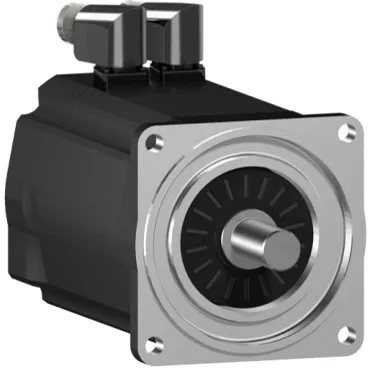
660 W servo motor with brake — speed and torque depend on your supply voltage
The SH31001M11F2000 is a three-phase servo motor from the SH3 series, delivering 660 W continuous power with an integrated holding brake rated at 9 N.m. The nominal speed shifts with the supply: 625 rpm at 115 V single-phase, 1250 rpm at 230 V single-phase, 2500 rpm at 400 V three-phase, and 3000 rpm at 480 V three-phase. Nominal torque also varies — 2.8 N.m at 115 V single-phase down to 2.52 N.m at 400 V or 480 V three-phase. That means the same motor behaves differently depending on whether you feed it from a single-phase or three-phase drive, so the drive selection and the application speed target must be matched to the available line voltage. The holding brake (9 N.m) is the key differentiator here — this motor is built for vertical-axis or safety-hold applications where the load must stay put when power is removed. The brake is engaged when the motor is at standstill, not for dynamic braking during deceleration. The peak stall torque of 9.6 N.m (at 115-480 V three-phase) gives the acceleration headroom for quick moves, while the continuous stall torque of 2.94 N.m tells you the motor can hold that torque at zero speed indefinitely without overheating — useful for tensioning or positioning against a stop.
Encoder and feedback — absolute single-turn Hiperface for position tracking
The encoder is an absolute single-turn SinCos Hiperface type. That means it reports the absolute position within one revolution (single-turn) without needing a homing sequence at power-up, and the SinCos signals give high-resolution analog position feedback to the drive. The Hiperface protocol is a common interface on Schneider and third-party drives — confirm your drive supports Hiperface (not just EnDat or BiSS) before wiring. The rotatable right-angled connector on the motor lets you orient the cable exit in the field, which helps when routing the feedback and power cables in a tight cabinet or on a moving axis. The motor has 4 poles, so the electrical frequency at 3000 rpm is 100 Hz. The stator inductance (34.7 mH) and resistance (13.9 Ohm) are the parameters the drive needs for auto-tuning the current loop. The torque constant is 1.63 N.m/A at 120 °C — that is the hot-winding value, so the drive's current limit should be set with the motor at operating temperature to avoid over-torque at cold start. The back EMF constant is 115 V/krpm at 20 °C, which means at 3000 rpm the motor generates about 345 V line-to-line — the drive DC bus must be high enough to overcome that voltage at speed.
Mounting, shaft, and environmental sealing
The motor mounts on an international standard flange with a 100 mm flange size and a 95 mm centring collar diameter — this is the B5 or B14 equivalent pattern common on European servo mounts. The shaft is 19 mm diameter with a parallel key (6 mm key width) and a 40 mm shaft length. The centring collar depth is 3.5 mm. The maximum radial force (Fr) derates with speed: 900 N at 1000 rpm, dropping to 530 N at 5000 rpm. If you are driving a belt or an overhung load, check the radial load at the operating speed against that curve. The maximum axial force (Fa) is 160 N. The IP rating depends on the shaft bushing configuration: IP54 with the standard shaft bushing (no shaft seal ring), IP65 with the shaft seal ring fitted. The motor body itself is rated IP65. For washdown or dusty environments, specify the shaft seal option. Cooling is natural convection — no fan, so the continuous torque rating assumes free air circulation around the motor body. The winding insulation class is rated for a copper hot-spot temperature of 130 °C. The overall length is 199.5 mm.