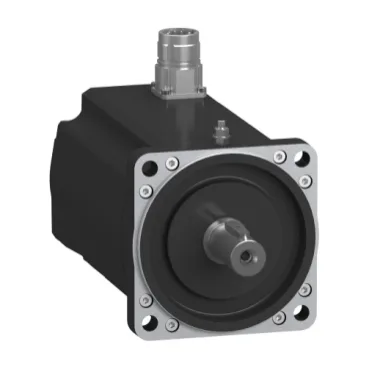
Motor ratings across supply configurations
The SH31001P1AA3100 delivers 1190 W continuous power on three-phase 400 V or 480 V supply, dropping to 690 W on 230 V single-phase input. Nominal speed reaches 2500 rpm on 230 V single-phase, 5000 rpm on 400 V three-phase, and 6000 rpm on 480 V three-phase — the 6000 rpm ceiling also matches the maximum mechanical speed limit. Nominal torque is 2.64 Nm on 230 V single-phase and 2.27 Nm on either 400 V or 480 V three-phase supply.
Encoder, feedback, and control interface
Fitted with an absolute single-turn Hiperface DSL encoder — a digital serial interface that carries position and temperature data over a single cable pair, simplifying the feedback wiring compared to incremental or multi-cable resolver systems. The back EMF constant is 60 V/krpm at 20 °C, and the torque constant is 0.84 Nm/A at 120 °C hot copper — both values needed for drive tuning and thermal limit calculations.
Mechanical integration and environmental sealing
Mounts on an international standard flange with a 100 mm flange size, 95 mm centring collar, and 9.0 mm mounting holes — fits the common IEC frame pattern for direct coupling to gearboxes or linear actuators. IP65 rating applies to both the motor body and the shaft bushing per IEC 60034-5, so the unit withstands washdown and dust ingress without an additional cover — suitable for food processing or wet machining environments. Electrical connection uses a rotatable right-angled connector or a quicklock straight connector — the rotatable option helps route the cable in tight panel or machine-frame corners.
Torque capability and thermal limits
Continuous stall torque is 2.94 Nm across the 115–480 V three-phase range, with a continuous stall current of 3.5 A — this is the torque the motor can hold indefinitely at standstill without overheating. Peak stall torque reaches 9.6 Nm on three-phase supply — roughly 3.3× the continuous rating — for acceleration or overload transients, limited by the 12 A maximum RMS current. Cooling is natural convection only — no external fan or forced air, so the duty cycle and ambient temperature must stay within the natural thermal envelope defined by the 130 °C hot copper limit.