What the speed and torque curves tell you
The SH31002M01F2100 delivers nominal torque between 5.28 N.m and 5.5 N.m depending on supply voltage, with a peak stall torque of 18.3 N.m across the 115-480 V three-phase range — that's over 3× the continuous rating for short-duration moves, useful for breaking inertia on a pick-and-place gantry without oversizing the frame. Nominal speed climbs from 500 rpm at 115 V single phase to 2400 rpm at 480 V three phase, so the same motor covers both low-speed high-torque indexing and higher-speed transfer applications depending on the drive voltage you feed it. The 4-pole construction and stator inductance of 24.3 mH give this motor a smooth torque profile down to low speeds — expect clean low-speed regulation without cogging visible on the velocity loop.
Brake and encoder — what's built in
The absolute single-turn SinCos Hiperface encoder eliminates the need for a home cycle on power-up — the drive knows the rotor position immediately, which saves time on multi-axis machines where each axis would otherwise need to find its reference. Natural convection cooling means no fan to fail or collect debris — the 1100 W continuous power rating is sustained without forced airflow, so the motor can run in dusty environments without a cooling fan intake pulling in contamination.
Mounting and mechanical interface
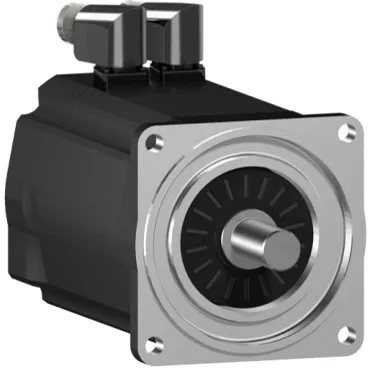
The 100 mm flange size (IEC standard) with a 95 mm centring collar and 3.5 mm collar depth bolts directly to standard metric motor mounts — the four 9.0 mm mounting holes line up with M8 hardware. Smooth shaft end, 19 mm diameter by 40 mm long, with a 6 mm keyway — the smooth shaft means no keyway stress riser, but you'll need a clamping-type coupling rather than a keyed one. The rotatable right-angled connector lets you orient the cable exit in 90° increments — useful when the motor is mounted in a tight cabinet corner where a straight connector would hit the enclosure wall.
Protection and environmental rating
Maximum radial force derates with speed: 990 N at 1000 rpm, dropping to 620 N at 4000 rpm — if you're driving a belt or chain directly from the shaft, check the belt tension against the radial force limit at your operating speed. Maximum axial force is 160 N — keep thrust loads from helical gears or leadscrews below this figure, or add an external thrust bearing to protect the motor bearings.