Power, torque, and speed — the operating envelope
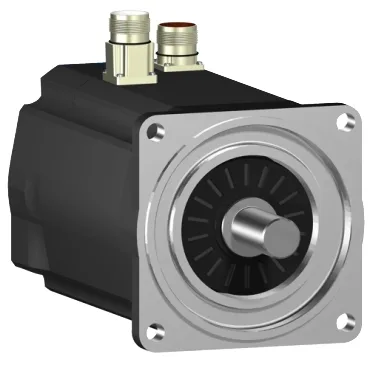
The SH31002M02A1000: Continuous output power is 1.1 kW (1090 W at 400 V three-phase), with nominal torque of 5.62 Nm at 2000 rpm on the same supply — this is the sustained duty point for a conveyor or spindle application. Peak stall torque reaches 18.3 Nm across the 115–480 V three-phase range, giving headroom for acceleration transients without oversizing the motor frame. Continuous stall torque is 5.8 Nm at 2.5 A continuous stall current — the thermal limit for holding torque at standstill under natural convection cooling.
Encoder and feedback — absolute multiturn Hiperface
The encoder is an absolute multiturn SinCos Hiperface type — it retains position through power cycles without a home sequence, which matters for applications where the axis must resume after a power loss without re-referencing. The back EMF constant is 146 V/krpm at 20 °C, and the torque constant is 2.32 Nm/A at 120 °C hot copper — these define the voltage/speed ceiling and the current-to-torque gain for the drive tuning.
Mounting and environmental fit
The motor mounts on an international standard flange with a 100 mm flange size and 95 mm centring collar — this is the IEC 100 frame pattern, common for direct coupling to gearboxes and linear actuators. IP65 protection on the motor body and shaft bushing means it withstands washdown and dust ingress per IEC 60034-5, suitable for food-and-bev or wet machining environments. Natural convection cooling keeps the envelope simple — no external fan or plumbing. Smooth shaft (no keyway) with 19 mm diameter and 40 mm shaft length — confirm the coupling bore and clamping method match this plain shaft profile before specifying.
Electrical and thermal limits
Stator resistance is 8.6 Ω and inductance is 24.3 mH — these set the electrical time constant and influence the drive's current-loop tuning. Maximum RMS current is 9.0 A, with a 3-second peak of the same value. Hot-spot copper temperature is rated at 130 °C — the motor can sustain full rated torque at this winding temperature without insulation degradation. Maximum radial force at the shaft is 990 N at 1000 rpm, derating to 620 N at 4000 rpm; maximum axial force is 160 N — these bound the allowable belt or gear load on the bearing.