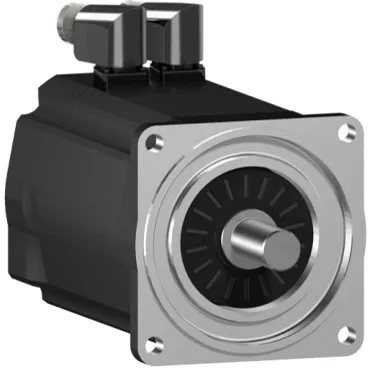
Speed and torque across supply voltages
This SH31002M02F2200 servo motor delivers different nominal speeds depending on the supply: 500 rpm on 115 V single phase, 1000 rpm on 230 V single phase, 2000 rpm on 400 V three phase, and 2400 rpm on 480 V three phase. Nominal torque also shifts with the supply — 5.62 Nm at 115 V single phase, 5.5 Nm at 230 V single phase, and 5.28 Nm on both 400 V and 480 V three-phase supplies. Peak stall torque is 18.3 Nm across the 115 to 480 V three-phase range, giving a healthy overload margin for acceleration and deceleration transients.
Brake and encoder — what locks and what tracks
The integrated holding brake delivers 9 Nm of holding torque — enough to hold the load on a vertical axis when power is removed, without needing an external brake resistor or mechanical lock. Feedback comes from an absolute multiturn SinCos Hiperface encoder, which means the drive knows the rotor position at power-up without a homing sequence — critical for applications where the machine must resume from the last known position after a power cycle.
Environmental sealing and mechanical limits
The motor body and shaft bushing carry IP65 per IEC 60034-5, and the housing is rated IP67 — the motor handles washdown environments and coolant splash without additional shrouding. Maximum radial force on the shaft drops from 990 N at 1000 rpm to 620 N at 4000 rpm — factor this into the belt-drive or direct-coupling design to avoid bearing overload at higher speeds. Maximum axial force is 160 N, so any external thrust load (from a leadscrew or helical gear) must stay below that limit or a thrust bearing must be added externally.
Sourcing and lifecycle — current production, quoted to order
The motor flange is the international standard 100 mm size (3.9 in) with a 95 mm centring collar and 9 mm mounting holes — fits the common IEC frame pattern for direct replacement in existing machine builds.