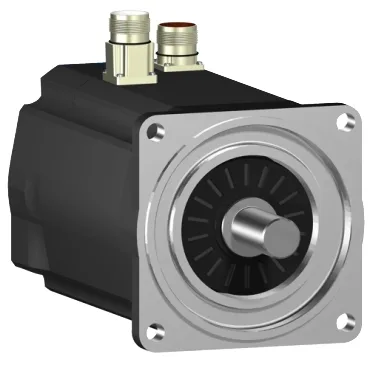
Speed-torque envelope across supply voltages
The SH31002M11A1100: This SH3 frame servo delivers 1100 W continuous power, but the nominal speed and torque shift with the supply. At 400 V three-phase it spins 2000 rpm with 5.28 N.m; on 480 V three-phase the same torque holds at 2400 rpm. Single-phase 230 V drops the speed to 1000 rpm at 5.5 N.m, and 115 V single-phase runs 500 rpm at 5.62 N.m. The peak stall torque of 18.3 N.m is available across the 115...480 V three-phase range for short accelerations.
Feedback and environmental sealing
The encoder is an absolute single-turn SinCos Hiperface — single-turn means position is known on power-up within one revolution; no homing cycle needed for rotary applications that stay within 360°. The Hiperface protocol is common on Schneider drives and third-party servo drives that support the interface. IP65 per IEC 60034-5 on both the motor body and the shaft bushing — the seal at the shaft exit is the wet-end barrier, not just the housing. This suits washdown environments in food-and-bev or packaging lines where hose-down cleaning is routine.
No holding brake — plan the axis hold
This variant ships without a holding brake. On a vertical axis or any load that must stay put when the drive is disabled, the application needs either an external brake, a mechanical counterbalance, or the drive's holding torque at zero speed (the continuous stall torque is 5.8 N.m, but the drive must remain enabled to hold it). If the machine cycle includes long stopped periods with the drive off, spec the braked variant instead.
Sourcing and lifecycle — active production
The electrical connection is a straight connector — no right-angle or cable-whip variant here. Confirm the mating connector part number from the drive-side interface before committing the panel layout.