Motor ratings that decide the drive pairing
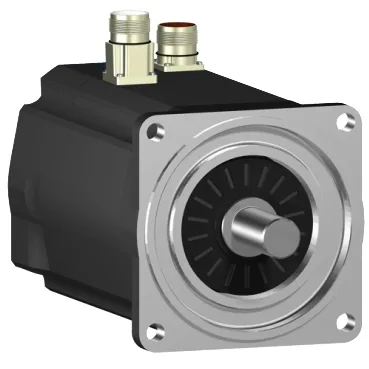
The SH31002M11F1100 is a 1.1 kW continuous-power servo motor from the Schneider SH3 family, built with a holding brake and an absolute single-turn SinCos Hiperface encoder. The encoder eliminates the need for a homing sequence on power-up — the position is known immediately, which saves 200–500 ms per cycle in a pick-and-place or rotary-index application. The motor is 4-pole, so synchronous speed is 3000 rpm at 50 Hz and 3600 rpm at 60 Hz. The nominal speed curve varies with supply voltage: 500 rpm at 115 V single-phase, 1000 rpm at 230 V single-phase, 2000 rpm at 400 V three-phase, and 2400 rpm at 480 V three-phase. This means the same motor can serve 50 Hz and 60 Hz markets, but the drive must be configured for the actual line voltage to get the rated torque-speed envelope.
Brake, encoder, and mechanical interface
The holding brake delivers 9 N.m static torque, which holds a vertical-axis load without power — critical for Z-axis safety on gantries or elevators. The brake engages when power is removed, so the load stays put during an E-stop or power loss. The encoder is absolute single-turn SinCos Hiperface — 17-bit or 18-bit resolution typical for this class. The absolute position is retained through power cycles, so the controller does not need to re-reference the axis on every startup. The SinCos analog track provides fine interpolation for velocity control down to single-digit rpm. The shaft is 19 mm diameter with a parallel key, 40 mm shaft length, and a 6 mm key width. The flange is 100 mm with a 95 mm centring collar and 3.5 mm centring depth — standard IEC mounting pattern. The straight connector exits the motor body in a fixed direction, so plan the cable route before panel layout.
Thermal limits and bearing loads — what the numbers mean for the application
Cooling is natural convection — no fan. The motor relies on its own surface area and the mounting flange to dissipate heat. Continuous stall torque is 5.8 N.m across the 115–480 V three-phase range, but the torque constant is specified at 2.32 N.m/A at 120°C copper temperature. If the duty cycle keeps the winding below 130°C, the motor can hold that torque indefinitely. Above that, the winding insulation life halves for every 10°C rise. Stator resistance is 8.6 Ω and inductance is 24.3 mH — the electrical time constant is about 2.8 ms. This is fast enough for current-loop bandwidths up to about 500 Hz in the drive, but the inductance limits the current slew rate at high switching frequencies. The drive's PWM frequency and DC bus voltage determine the actual current ripple. Maximum radial force is 990 N at 1000 rpm, derating to 620 N at 4000 rpm. Maximum axial force is 160 N. These are the bearing load limits — overshoot them and the bearing life drops below the L10 rating. For a belt-drive or direct-couple application, the radial load from belt tension must stay under the curve at the operating speed.
The IP65 rating applies to both the motor body and the shaft bushing per IEC 60034-5 — the motor withstands washdown and dust ingress without an additional cover. This makes it suitable for food-and-beverage, pharmaceutical, or outdoor conveyor applications where hose-down cleaning is routine.