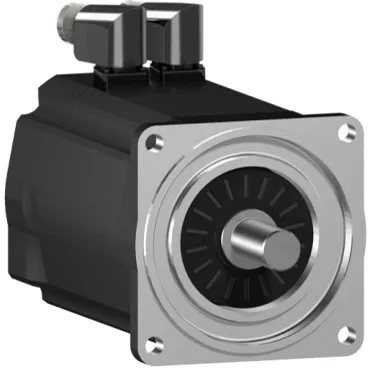
What the flange size and power mean for fit
The SH31002M11F2100 is a 1100 W servo motor with an integrated holding brake, built on a 100 mm international standard flange (3.9 in). That flange size tells you it replaces or matches the B5 / IM B5 mounting pattern common across European machine-tool frames — no need to re-drill the mounting plate if you're swapping out an older servo of similar power class. The motor is naturally convection-cooled (no external fan), so it relies on the machine structure or ambient airflow for heat rejection. In a retrofit on an older machine that had a fan-cooled motor, check that the mounting orientation and enclosure don't trap heat — the copper winding temperature ceiling is 266 °F (130 °C).
Speed and torque across supply voltages
This motor's nominal speed depends on the supply you feed it: 500 rpm at 115 V single phase, 1000 rpm at 230 V single phase, 2000 rpm at 400 V three phase, and 2400 rpm at 480 V three phase. The nominal torque holds fairly flat across those voltages — around 5.5 N.m — so the power output scales linearly with speed: 300 W at 115 V single phase up to 1280 W at 480 V three phase. The peak stall torque is 18.3 N.m across the 115–480 V three-phase range, which gives you a 3.3× overload margin over the continuous stall torque of 5.8 N.m. That's enough for acceleration under load without oversizing the drive.
Encoder and feedback — Hiperface absolute single-turn
The encoder is an absolute single-turn SinCos Hiperface type. That means it reports position on every power-up without a homing move — critical for applications like pick-and-place or rotary indexing where the machine must know its exact position after a power cycle. The SinCos analog track also gives interpolated resolution beyond the raw line count, useful for velocity ripple smoothing. The electrical connection is a rotatable right-angled connector, so the cable exit can be oriented in 90° increments around the motor body. That helps when the motor is shoehorned into a tight cavity — you can point the connector away from the machine frame or the chip tray.
Load ratings — radial and axial forces
The maximum radial force (Fr) on the shaft drops with speed: 990 N at 1000 rpm, 790 N at 2000 rpm, 690 N at 3000 rpm, 620 N at 4000 rpm. If you're direct-coupling a heavy pulley or gear, check that the belt tension or gear mesh force stays under the curve at your running speed. Axial force (Fa) is capped at 160 N — fine for a helical coupling or light thrust load, but not for a leadscrew that pushes against the motor bearings. The shaft is 19 mm diameter with a parallel key (6 mm key width, 40 mm shaft length). That's a standard metric shaft end for couplings in this power class — common off-the-shelf jaw or bellows couplings will fit without a custom bore.
The motor is IP65-rated on both the body and the shaft bushing (conforming to IEC 60034-5).