Speed and torque across the supply range
The SH31002M12A1000: This SH3-frame motor delivers different speed-torque curves depending on what supply you feed it. On three-phase 400-480 V it spins 2000-2400 rpm with 46.73 lbf.in (5.28 N.m) nominal torque. Drop to single-phase 115 V and the nominal speed falls to 500 rpm, but torque actually rises slightly to 49.74 lbf.in (5.62 N.m) — the motor compensates for the lower voltage by drawing more current within its thermal limit. The continuous stall torque holds steady at 5.8 N.m across the full 115-480 V three-phase range, so the machine's holding torque at zero speed doesn't change when you swap line voltages. Peak stall torque reaches 18.3 N.m for short overloads — useful for breaking away a stuck load.
Encoder choice for retrofit jobs
The absolute multiturn SinCos Hiperface encoder means this motor remembers its shaft position after power loss — no homing sequence on restart. That's the main reason to pick this over a resolver-based motor when you're swapping into an older machine that didn't have absolute feedback. The multiturn count tracks multiple revolutions, so a ball screw or conveyor position is retained across power cycles.
Mounting and environmental fit
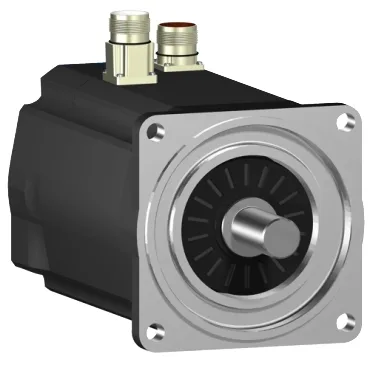
The motor flange is the international standard 100 mm (3.9 in) pattern with a 95 mm centring collar and 9 mm mounting holes — drops into any standard IEC or NEMA 100 mm face-mount without adapter plates. Shaft is 19 mm diameter with a parallel key, 40 mm shaft length. IP54 at the shaft bushing without the seal ring; the motor body itself is IP65. If the machine sees washdown or coolant spray, add the shaft seal ring — without it, moisture can track along the shaft into the bearing housing. Natural convection cooling means no fan noise or filter maintenance, but derate the continuous torque if the ambient around the motor exceeds the 130°C copper hot-spot limit.
Radial load limits at speed
Maximum radial force Fr drops from 990 N at 1000 rpm to 620 N at 4000 rpm. If the driven load is a belt or direct-coupled pulley, check the belt tension against that curve — a tight belt at high speed can overload the front bearing long before the motor thermally trips.
Sourced through independent distribution channels. No stock-holding claim; quoted per RFQ.