Motor ratings across supply voltages — the selection matrix
The SH31002M12A2200: This SH3 frame servo delivers different performance depending on the supply. At 400 V three-phase, nominal torque is 5.28 Nm at 2000 rpm, with nominal output power of 1090 W. On 480 V three-phase, the same torque holds at 5.28 Nm but output climbs to 1280 W at 2400 rpm. Single-phase 115 V drops torque to 5.62 Nm at 500 rpm and output to 300 W — so the drive supply voltage directly dictates the usable speed-torque envelope. Peak stall torque is 18.3 Nm across the 115-480 V three-phase range, with a 3-second peak current of 9.0 A. That gives you the acceleration headroom for short-duration moves without oversizing the drive.
Encoder and drive pairing — the Hiperface interface
The motor carries an absolute multiturn SinCos Hiperface encoder. That means it reports position on power-up without a homing move — the drive reads the absolute position from the encoder's multiturn count. Pair this motor with a Schneider Lexium drive that supports Hiperface; the SinCos analog tracks give fine velocity feedback down to standstill. Stator resistance is 8.6 Ω, inductance 24.3 mH — these feed the autotune routine in the drive for current loop gains.
Physical fit — flange, shaft, and IP rating
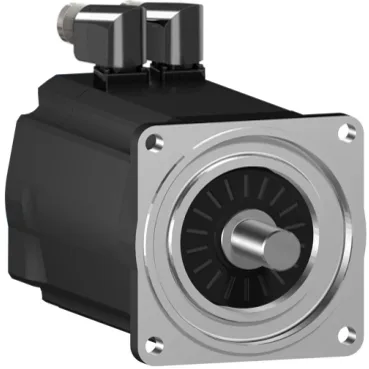
Mounting is a 100 mm international standard flange with a 95 mm centring collar and 9.0 mm mounting holes. The shaft is 19 mm diameter with a parallel key, 40 mm long — standard for this frame size. Overall length is 204.5 mm, so check your cavity depth before committing. IP65 on the motor body and shaft bushing, IP67 on the housing — conforming to IEC 60034-5. That means it handles washdown spray from any direction, but the shaft seal is the wet-end barrier; the connector O-ring on the straight or rotatable right-angle connector needs to be seated properly to maintain the rating.
Continuous thermal limits and cooling
Continuous stall torque is 5.8 Nm at 2.5 A across the 115-480 V range. Continuous power is 1100 W — that's the sustained output before the winding hits the 130 °C copper hot-spot temperature. Cooling is natural convection, so no fan or external airflow is required, but the motor must be mounted with free air circulation around the frame.