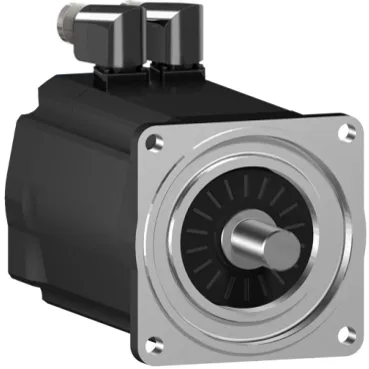
Motor frame and mounting — 100 mm flange, 234.5 mm body
The SH31002P01F2100 uses an international standard flange with a 3.9 in (100 mm) bolt circle and 0.4 in (9.0 mm) mounting holes. Centring collar diameter is 3.7 in (95 mm) with a 0.1 in (3.5 mm) depth — that collar registers the motor concentric to the load, not the bolt pattern. Overall length is 9.2 in (234.5 mm) with a smooth shaft 0.7 in (19 mm) diameter and 1.6 in (40 mm) shaft length. The rotatable right-angled connector lets you route the cable out the side or rear without adding a right-angle adapter — useful when the motor sits tight against a machine frame.
Speed-torque envelope — voltage-dependent performance
This is a 4-pole motor, so its nominal speed shifts with the supply: 1000 rpm at 115 V single-phase, 2000 rpm at 230 V single-phase, 4000 rpm at 400 V three-phase, and 4800 rpm at 480 V three-phase. The nominal torque drops as voltage rises — 5.5 Nm at 115 V down to 4.4 Nm at 480 V — because the motor's torque constant (1.21 Nm/A at 120 °C) is fixed by the winding, and the available current changes with the drive's DC bus. Continuous stall torque is 5.8 Nm across the 115–480 V three-phase range, with a peak stall torque of 18.3 Nm. That 3:1 peak-to-continuous ratio means the motor can handle short overloads for acceleration or reversing without tripping the drive — useful on indexing or pick-and-place axes. Continuous power is 1900 W, but nominal output power varies from 580 W (115 V single-phase) to 2210 W (480 V three-phase). The 17.1 A maximum current (Irms) and same 3-second peak current set the drive sizing floor — the drive must deliver at least 17.1 A continuous to get full motor torque.
Feedback and brake — Hiperface encoder, 9 Nm holding brake
The absolute single-turn SinCos Hiperface encoder gives position feedback on power-up without a homing move — the drive reads the absolute position from the encoder's single-turn count. SinCos (sine-cosine) signals let the drive interpolate between encoder lines for higher effective resolution than a pure digital encoder of the same line count.
Environmental and cooling — IP65, natural convection
IP65 per IEC 60034-5 on both the motor body and the shaft bushing means the motor withstands hose-down and dust ingress — the shaft bushing seal is the weak point on most servos, and this one carries the same rating as the housing. No external fan or forced air required; natural convection cooling keeps the winding temperature at 130 °C hot-spot. Maximum radial force at the shaft is 990 N at 1000 rpm, dropping to 620 N at 4000 rpm — the bearing life is limited by radial load at high speed, not by the motor's torque. Maximum axial force is 160 N, so any thrust load from a helical gear or lead screw must stay under that or use an outboard bearing.
Electrical parameters — winding data for drive tuning
Stator resistance is 2.4 Ω and inductance is 6.75 mH — these set the electrical time constant (L/R ≈ 2.8 ms) that the drive's current loop must handle. The back EMF constant is 77 V/krpm at 20 °C, so at 4000 rpm the motor generates 308 V line-to-line — the drive's DC bus must stay above that to maintain current control. Torque constant is 1.21 Nm/A at 120 °C hot copper — the winding resistance rises with temperature, so the actual torque per amp at cold start is slightly higher. The 130 °C copper temperature limit is the winding insulation class; the drive's thermal model should use this as the motor protection threshold.