Speed and torque depend on the supply voltage — not a fixed-rating motor
The SH31004P01F2200 is a three-phase servo motor but its nominal speed and torque shift significantly with the supply voltage. At 115 V single-phase it delivers 750 rpm and 9.9 N·m; at 230 V single-phase, 1500 rpm and 9.5 N·m; at 400 V three-phase, 3000 rpm and 7.9 N·m; at 480 V three-phase, 3600 rpm and 6.9 N·m. The drive must be parameterised for the actual line voltage — the motor does not auto-detect the supply. Continuous power is 2500 W, but the nominal output power varies: 780 W on 115 V single-phase, 1490 W on 230 V single-phase, 2480 W on 400 V three-phase, and 2600 W on 480 V three-phase. The peak stall torque reaches 40.5 N·m across the three-phase range, and the maximum current Irms is 32.3 A — the drive must be sized for that peak current, not the continuous rating.
Brake and encoder — what the holding torque and feedback type mean for the application
The holding brake delivers 12 N·m (106.2 lbf·in) — enough to hold a vertical-axis load at standstill without servo current. The brake is engaged when the motor is unpowered; it is released by the drive's brake control output. Confirm the drive's brake voltage and current rating match the motor's brake coil spec before wiring. The encoder is an absolute single-turn SinCos Hiperface type. Single-turn means position is retained within one revolution after power loss, but absolute position over multiple turns is not stored — a homing sequence is required on power-up if the application needs multi-turn position. The SinCos interface is analogue sine/cosine with a digital Hiperface protocol; the drive must support Hiperface, not just EnDat or BiSS.
Environmental sealing and mechanical fit
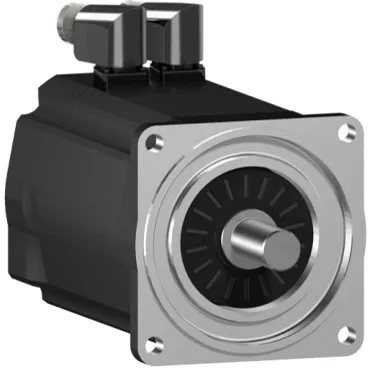
IP65 on the motor body and shaft bushing, IP67 on the housing — the motor survives washdown and hose-directed water, but the connector must be mated with the correct IP-rated cordset to maintain the seal. The rotatable right-angled connector allows the cable exit to be oriented in 4 x 90° positions, which helps in tight cable-tray layouts. The motor flange is 100 mm (3.9 in) with a 95 mm centring collar and 9 mm mounting holes. The smooth shaft is 24 mm diameter, 50 mm long. Maximum radial force at 3000 rpm is 740 N; at 1000 rpm it is 1070 N — the load coupling must stay within these limits to avoid bearing damage.